

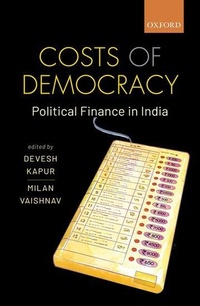
Costs of Democracy
Political Finance in India
Published on 9. August 2018
Book
Hardback
312 pages
978-0-19-948727-1 (ISBN)
Description
If it impossible to conceive of democracies sans elections, why is it impossible to imagine elections without the flood of money in politics? How does every general election in India get more expensive than the last one? Stepping into the mucky terrain to find out what enables the average Indian vote to have a price, Costs of Democracy opens readers' eyes to the opaque and enigmatic ways in which money flows through the political heart of the world's largest democracy.
In the first in-depth investigation drawing from extensive fieldwork on political campaigns, unique surveys, and creative and innovative data analysis, the contributions chase and unpack the institutional and regulatory context governing the flow of money in politics; the sources of political finance; the need for such large spending; how money flow, operate, and interact with different levels of government.
In the first in-depth investigation drawing from extensive fieldwork on political campaigns, unique surveys, and creative and innovative data analysis, the contributions chase and unpack the institutional and regulatory context governing the flow of money in politics; the sources of political finance; the need for such large spending; how money flow, operate, and interact with different levels of government.
More details
Language
English
Place of publication
New Delhi
India
Target group
Professional and scholarly
Product notice
sewn/stitched
Cloth over boards
Illustrations
15 Tables; 13 Figures
Dimensions
Height: 224 mm
Width: 145 mm
Thickness: 28 mm
Weight
417 gr
ISBN-13
978-0-19-948727-1 (9780199487271)
Copyright in bibliographic data and cover images is held by Nielsen Book Services Limited or by the publishers or by their respective licensors: all rights reserved.
Schweitzer Classification
Other editions
Additional editions
E-Book
06/2018
1st Edition
OUP
€39.59
Available for download
Persons
Milan Vaishnav is a Senior Fellow in the South Asia Program at the Carnegie Endowment for International Peace. His primary research focus is the political economy of India, and he examines issues such as corruption and governance, state capacity, distributive politics, and electoral behaviour. He is the author of When Crime Pays: Money and Muscle in Indian Politics (Yale University Press/HarperCollins India 2017) and co-editor (with Devesh Kapur and Pratap Bhanu Mehta) of Rethinking Public Institutions in India (Oxford University Press 2017). Previously, he worked at the Center for Global Development, where he served as a postdoctoral research fellow; the Center for Strategic and International Studies; and the Council on Foreign Relations. He has taught at Columbia, Georgetown, and George Washington universities. He holds a PhD in political science from Columbia University.
Devesh Kapur is the Madan Lal Sobti Professor for the Study of Contemporary India and Director, Center for Advanced Study of India, University of Pennsylvania; and Non-Resident fellow at the Center for Global Development, Washington, D.C. He is the coauthor of The World Bank: Its First Half Century; Public Institutions in India: Performance; and Design and Against the Odds: The Rise of Dalit Entrepreneurs. His three books on international migration examine the effects at a global level (Give us your Best and Brightest: The Global Hunt for Talent and Its Impact on the Developing World); and on the country of emigration (Diaspora, Democracy and Development: The Impact of International Migration from India on India published by Princeton University Press which received the 2012 Distinguished Book Award of the International Studies Association).
Devesh Kapur is the Madan Lal Sobti Professor for the Study of Contemporary India and Director, Center for Advanced Study of India, University of Pennsylvania; and Non-Resident fellow at the Center for Global Development, Washington, D.C. He is the coauthor of The World Bank: Its First Half Century; Public Institutions in India: Performance; and Design and Against the Odds: The Rise of Dalit Entrepreneurs. His three books on international migration examine the effects at a global level (Give us your Best and Brightest: The Global Hunt for Talent and Its Impact on the Developing World); and on the country of emigration (Diaspora, Democracy and Development: The Impact of International Migration from India on India published by Princeton University Press which received the 2012 Distinguished Book Award of the International Studies Association).
Content
Table of Contents
List of Tables
List of Figures
Acknowledgments
List of Abbreviations
Introduction
Devesh Kapur and Milan Vaishnav
1. Political Finance in a Developing Democracy: The Case of India
Eswaran Sridharan and Milan Vaishnav
2. Money in Elections: The Role of Personal Wealth on Election Outcomes
Neelanjan Sircar
3. Builders, Politicians, and Election Finance
Devesh Kapur and Milan Vaishnav
4. Navigating Fiscal Constraints: Dalit Parties and Coalition Politics in Tamil Nadu, India
Michael A. Collins
5. Money and Votes: Following Flows through Mumbai and Bihar
Lisa Bjoerkman and Jeffrey Witsoe
6. What Costs So Much in Indian Elections? Intuitions from Recent Electoral Campaigns in Mumbai
Simon Chauchard
7. Whose Money, Whose Influence? Multi-level Politics and Campaign Finance in India
Jennifer Bussell
Conclusion: Implications for Research and Policy
Devesh Kapur, Eswaran Sridharan, and Milan Vaishnav
Index
About the Editors and Contributors
List of Tables
List of Figures
Acknowledgments
List of Abbreviations
Introduction
Devesh Kapur and Milan Vaishnav
1. Political Finance in a Developing Democracy: The Case of India
Eswaran Sridharan and Milan Vaishnav
2. Money in Elections: The Role of Personal Wealth on Election Outcomes
Neelanjan Sircar
3. Builders, Politicians, and Election Finance
Devesh Kapur and Milan Vaishnav
4. Navigating Fiscal Constraints: Dalit Parties and Coalition Politics in Tamil Nadu, India
Michael A. Collins
5. Money and Votes: Following Flows through Mumbai and Bihar
Lisa Bjoerkman and Jeffrey Witsoe
6. What Costs So Much in Indian Elections? Intuitions from Recent Electoral Campaigns in Mumbai
Simon Chauchard
7. Whose Money, Whose Influence? Multi-level Politics and Campaign Finance in India
Jennifer Bussell
Conclusion: Implications for Research and Policy
Devesh Kapur, Eswaran Sridharan, and Milan Vaishnav
Index
About the Editors and Contributors