

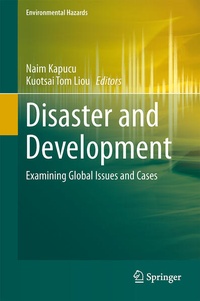
Disaster and Development
Examining Global Issues and Cases
Published on 28. April 2014
Book
Hardback
XIX, 469 pages
978-3-319-04467-5 (ISBN)
Description
This book offers a systematic, empirical examination of the concepts of disasters and sustainable economic development applied to many cases around the world. It presents comprehensive coverage of the complex and dynamic relationship between disaster and development, making a vital contribution to the literature on disaster management, disaster resilience and sustainable development. The book collects twenty-three chapters, examining theoretical issues and investigating practical cases on policy, governance, and lessons learned in dealing with different types of disasters (e.g., earthquakes, floods and hurricanes) in twenty countries and communities around the world.
Reviews / Votes
From the book reviews:
"Naim Kapucu and Kuotsai Tom Liou's Disaster and Development: Examining Global Issues and Cases is a welcome addition to a growing body of literature exploring practices in emergency management worldwide. . The volume is ideal for advanced courses in emergency management and disaster studies or as a reference on the diversity of international approaches to recent disasters." (Jessica Bonnan-White, Natural Hazards Observer, Vol. XXXIX (3), January, 2015)More details
Series
Language
English
Place of publication
Cham
Switzerland
Publishing group
Springer International Publishing
Target group
Professional and scholarly
Research
Illustrations
15 s/w Abbildungen, 19 farbige Abbildungen
XIX, 469 p. 34 illus., 19 illus. in color.
Dimensions
Height: 241 mm
Width: 160 mm
Thickness: 32 mm
Weight
898 gr
ISBN-13
978-3-319-04467-5 (9783319044675)
DOI
10.1007/978-3-319-04468-2
Schweitzer Classification
Other editions
Additional editions
Book
09/2016
Springer
€160.49
Shipment within 10-15 days
E-Book
04/2014
1st Edition
Springer
€149.79
Available for download
Content
Part I- Risk Reduction and Policy Learning.- Part II- Disaster Resilience and Capacity Building.- Part III- Recovery, Development, and Collaborative Emergency Management.