

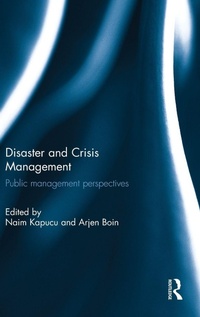
Disaster and Crisis Management
Public Management Perspectives
1st Edition
Published on 24. August 2015
Book
Hardback
174 pages
978-1-138-93516-7 (ISBN)
Description
A wide range of natural hazards pose major risks to the lives and livelihoods of large populations around the world. Man-made disasters caused by technological failures, industrial accidents, spillages, explosions, and fires, compound this threat. Since 9/11, security threats based on violence (terrorism, insurgency, and civil strife) have attracted much governmental attention and a great deal of public resources. As the scale, frequency, and intensity of disasters and crises have dramatically increased over the last decade, the failures in responding to these crises have prompted a critical need to evaluate the way in which the public sector responds to disaster.
What have we learned? What has changed in the management of disasters and crises? What do we know about the causes, patterns, and consequences of these events? This book looks at some of the approaches that can be taken to empirically examine disaster and crisis management practices. It contributes to the literature on crisis and disaster management, as well as social policy and planning. Introducing approaches that are applicable to a variety of circumstances in the U.S. and in other countries, it offers ways to think through policy interventions and governance mechanisms that may enhance societal resilience. This book was originally published as a special issue of Public Management Review.
What have we learned? What has changed in the management of disasters and crises? What do we know about the causes, patterns, and consequences of these events? This book looks at some of the approaches that can be taken to empirically examine disaster and crisis management practices. It contributes to the literature on crisis and disaster management, as well as social policy and planning. Introducing approaches that are applicable to a variety of circumstances in the U.S. and in other countries, it offers ways to think through policy interventions and governance mechanisms that may enhance societal resilience. This book was originally published as a special issue of Public Management Review.
More details
Language
English
Place of publication
London
United Kingdom
Publishing group
Taylor & Francis Ltd
Target group
College/higher education
Dimensions
Height: 240 mm
Width: 161 mm
Thickness: 14 mm
Weight
432 gr
ISBN-13
978-1-138-93516-7 (9781138935167)
Copyright in bibliographic data and cover images is held by Nielsen Book Services Limited or by the publishers or by their respective licensors: all rights reserved.
Schweitzer Classification
Other editions
Additional editions
E-Book
10/2017
1st Edition
Routledge
€69.99
Available for download
E-Book
10/2017
1st Edition
Routledge
€69.99
Available for download
Book
06/2017
1st Edition
Routledge
€76.40
Shipment within 10-20 days
Persons
Naim Kapucu is Professor of Public Policy and Administration in the School of Public Administration at the University of Central Florida, Orlando, USA. He has published widely in areas of public administration and emergency management, and has developed and taught emergency management and homeland security programmes at UCF.?
Arjen Boin is Professor of Public Institutions and Governance at the Institute of Political Science, Leiden University, The Netherlands. He has published widely on topics of crisis and disaster management. He is co-editor of?Public Administration and managing partner of Crisisplan BV.
Arjen Boin is Professor of Public Institutions and Governance at the Institute of Political Science, Leiden University, The Netherlands. He has published widely on topics of crisis and disaster management. He is co-editor of?Public Administration and managing partner of Crisisplan BV.
Content
Introduction: Studying Disaster and Crisis Management 1. Time and Crisis 2. The Vulnerability of Public Spaces: Challenges for UK hospitals under the 'new' terrorist threat 3. The Core and Periphery of Emergency Management Networks: A multi-modal assessment of two evacuation-hosting networks from 2000 to 2009 4. Managing Disaster Networks in India: A study of structure and effectiveness 5. Managing the Impact of Disaster: Patterns of post-tsunami sheltering and duration of stay in South India 5. Solidarity as Political Strategy: Post-crisis reform following the French heatwave 6. Making Groceries: Leadership, free spaces and narratives of meaning in post-Katrina New Orleans 7. The Resilient Organization: A critical appraisal 8. Economic Considerations in Designing Emergency Management Institutions and Policies for Transboundary Disasters