

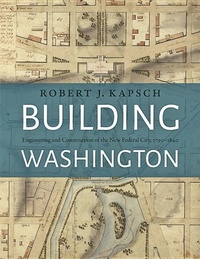
Building Washington
Engineering and Construction of the New Federal City, 1790?1840
Will be published approx. on 10. July 2018
Book
Hardback
384 pages
978-1-4214-2487-3 (ISBN)
Description
A richly illustrated behind-the-scenes tour of how the nation's capital was built.
In 1790, George Washington and Thomas Jefferson set out to build a new capital for the United States of America in just ten years. The area they selected on the banks of the Potomac River, a spot halfway between the northern and southern states, had few resources or inhabitants. Almost everything needed to build the federal city would have to be brought in, including materials, skilled workers, architects, and engineers. It was a daunting task, and these American Founding Fathers intended to do it without congressional appropriation.
Robert J. Kapsch's beautifully illustrated book chronicles the early planning and construction of our nation's capital. It shows how Washington, DC, was meant to be not only a government center but a great commercial hub for the receipt and transshipment of goods arriving through the Potomac Canal, then under construction. Picturesque plans would not be enough; the endeavor would require extensive engineering and the work of skilled builders.
By studying an extensive library of original documents-from cost estimates to worker time logs to layout plans-Kapsch has assembled a detailed account of the hurdles that complicated this massive project. While there have been many books on the architecture and planning of this iconic city, Building Washington explains the engineering and construction behind it.
In 1790, George Washington and Thomas Jefferson set out to build a new capital for the United States of America in just ten years. The area they selected on the banks of the Potomac River, a spot halfway between the northern and southern states, had few resources or inhabitants. Almost everything needed to build the federal city would have to be brought in, including materials, skilled workers, architects, and engineers. It was a daunting task, and these American Founding Fathers intended to do it without congressional appropriation.
Robert J. Kapsch's beautifully illustrated book chronicles the early planning and construction of our nation's capital. It shows how Washington, DC, was meant to be not only a government center but a great commercial hub for the receipt and transshipment of goods arriving through the Potomac Canal, then under construction. Picturesque plans would not be enough; the endeavor would require extensive engineering and the work of skilled builders.
By studying an extensive library of original documents-from cost estimates to worker time logs to layout plans-Kapsch has assembled a detailed account of the hurdles that complicated this massive project. While there have been many books on the architecture and planning of this iconic city, Building Washington explains the engineering and construction behind it.
Reviews / Votes
Rich in period detail thanks to Kapsch's extensive use of original documents, drawings and illustrations, and cost data for context, Building Washington is a fascinating look at the creation of the seat of our democracy.-Ray Bert, Civil Engineering Kapsch, a historian of engineering, focuses principally on the decades between the passage of the Residence Act of 1790, which selected the site for the new nation's capital, and the repair and reconstruction efforts that followed the burning of public buildings by British troops in 1814. The narrative centers on the transition from an eighteenth-century mode of construction led by "gentleman planters" to one orchestrated by professionally trained "architect-engineers." Along the way, Kapsch examines the supply chains, building techniques, financial expedients, and political wrangling that went into making the city.
-David Schley, Journal of Southern History Building Washington is a meticulously detailed account of the early construction of the capital city . . . The work will provide a treasure trove for research specialists in engineering and construction practices of the early republic and an informative reference work for enthusiastic Washingtonians.
-Thomas J. Brown, University of South Carolina, Journal of American History
More details
Language
English
Place of publication
Baltimore, MD
United States
Target group
Professional and scholarly
Product notice
sewn/stitched
Cloth over boards
Illustrations
83 s/w Abbildungen, 38 farbige Abbildungen
38 Illustrations, color; 83 Illustrations, black and white
Dimensions
Height: 287 mm
Width: 220 mm
Thickness: 40 mm
Weight
1588 gr
ISBN-13
978-1-4214-2487-3 (9781421424873)
DOI
10.1353/book.58680
Copyright in bibliographic data and cover images is held by Nielsen Book Services Limited or by the publishers or by their respective licensors: all rights reserved.
Schweitzer Classification
Other editions
Additional editions
E-Book
07/2018
Johns Hopkins University Press
€53.49
Available for download
Person
Robert J. Kapsch is a researcher and principal of the Center for Historic Engineering and Architecture. He is the author of The Potomac Canal: George Washington and the Waterway West, Historic Canals and Waterways of South Carolina, and Over the Alleghenies: Early Canals and Railroads of Pennsylvania.
Content
Timeline
Acknowledgments
Introduction
Part I
1. Pierre L'Enfant's Two Plans for Executing the President's Vision
2. Financing the Federal City
3. Constructing the Federal City
4. Developing a Commercial Center
5. Early Infrastructure and Transport Improvements
6. Building Military Defenses for the Capital
Part II
7. The First Public Building Campaign (1791-1802)
8. The Second Public Building Campaign (1803-1811)
9. The Third Public Building Campaign (1815-1824)
10. Later Transportation Improvements
Epilogue
Bibliography
Index
Acknowledgments
Introduction
Part I
1. Pierre L'Enfant's Two Plans for Executing the President's Vision
2. Financing the Federal City
3. Constructing the Federal City
4. Developing a Commercial Center
5. Early Infrastructure and Transport Improvements
6. Building Military Defenses for the Capital
Part II
7. The First Public Building Campaign (1791-1802)
8. The Second Public Building Campaign (1803-1811)
9. The Third Public Building Campaign (1815-1824)
10. Later Transportation Improvements
Epilogue
Bibliography
Index