

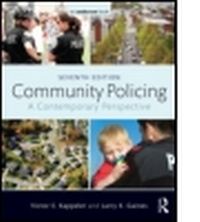
Community Policing
A Contemporary Perspective
7th Edition
Published on 15. February 2015
Book
Paperback/Softback
588 pages
978-0-323-34049-6 (ISBN)
Description
Community policing is a philosophy and organizational strategy that expands the traditional police mandate of fighting crime to include forming partnerships with citizenry that endorse mutual support and participation. The first textbook of its kind, Community Policing: A Contemporary Perspective delineates this progressive approach, combining the accrued wisdom and experience of its established authors with the latest research-based insights to help students apply what is on the page to the world beyond.
This seventh edition extends the road map presented by Robert Trojanowicz, the father of community policing, and brings it into contemporary focus. The text has been revised throughout to include the most current developments in the field, including "Spotlight on Community Policing Practice" features that focus on real-life community policing programs in various cities as well as problem-solving case studies. Also assisting the reader in understanding the material are Learning Objectives, Key Terms, and Discussion Questions, in addition to numerous links to resources outside the text. A glossary and an appendix, "The Ten Principles of Community Policing," further enhance learning of the material.
This seventh edition extends the road map presented by Robert Trojanowicz, the father of community policing, and brings it into contemporary focus. The text has been revised throughout to include the most current developments in the field, including "Spotlight on Community Policing Practice" features that focus on real-life community policing programs in various cities as well as problem-solving case studies. Also assisting the reader in understanding the material are Learning Objectives, Key Terms, and Discussion Questions, in addition to numerous links to resources outside the text. A glossary and an appendix, "The Ten Principles of Community Policing," further enhance learning of the material.
Reviews / Votes
Whether you are a professor, student or long time practitioner, you will find this book to contain a comprehensive and thought provoking overview of community policing.? It provides a perfect blend of factual historic considerations and implementation guidelines and should be required reading for everyone in the criminal justice field.- Commander Ken Armstrong, Lexington Division of Police (KY)
The strength of this text is that it thoroughly covers the philosophy of community policing and then explains how specific strategies and tactics fit within that philosophy. Only by understanding that link can students discern the difference between practices that truly are community policing and those that are not.
-Curtis G. Hayes, Criminal Justice, Western New Mexico University
I've used this textbook for my community policing courses for the past several years starting with the 5th edition. Nicely written, easy for criminal justice or non-criminal justice students to follow. Excellent resource that has been updated nicely. I look forward to using the 7th edition.
-Tim Gleason, Criminal Justice, University of Illinois, Springfield
More details
Edition
7th New edition
Language
English
Place of publication
Cincinnati
United States
Publishing group
Taylor & Francis Inc
Target group
College/higher education
Edition type
New edition
Illustrations
24 s/w Abbildungen, 28 farbige Abbildungen, 23 farbige Tabellen, 24 s/w Photographien bzw. Rasterbilder, 28 farbige Zeichnungen
28 Line drawings, color; 24 Halftones, black and white; 23 Tables, color; 28 Illustrations, color; 24 Illustrations, black and white
Dimensions
Height: 235 mm
Width: 187 mm
Weight
1270 gr
ISBN-13
978-0-323-34049-6 (9780323340496)
Copyright in bibliographic data and cover images is held by Nielsen Book Services Limited or by the publishers or by their respective licensors: all rights reserved.
Schweitzer Classification
Other editions
New editions
Victor E. Kappeler | Larry K. Gaines | Brian P. Schaefer
Community Policing
A Contemporary Perspective
Book
02/2020
8th Edition
Routledge
€101.50
Article exhausted; check for reprint
Additional editions
Book
02/2015
7th Edition
Routledge
€185.70
Withdrawn from sale
Persons
Victor E. Kappeler, a former police officer, is a Foundation Professor and Associate Dean of the School of Justice Studies at Eastern Kentucky University. He is recognized as a leading scholar in such fields as policing, media, and the social construction of crime, and police civil liability, among other related fields. Dr. Kappeler continues to provide in-service training for police officers and is well published in professional areas of policing. Among many other honors, Kappeler received the 2006 Cabinet for Justice and Public Safety Award for Academic Excellence and the 2005 Outstanding Criminal Justice Alumnus Award from Sam Houston State University, where he earned his doctoral degree, and the Lifetime Achievement Award from the American Society of Criminology's Division on Critical Criminology.
Larry K. Gaines is Professor and Chair of the Criminal Justice Department at California State University, San Bernardino. He served as the Executive Director of the Kentucky Association of Chiefs of Police for 14 years and has consulted with a variety of police agencies in Kentucky, Ohio, Tennessee, Georgia, and California. Dr. Gaines has served as Secretary, Treasurer, and President of the Academy of Criminal Justice Sciences. He has received many awards, including the Founders Award from the Academy of Criminal Justice Sciences, the Outstanding Educator Award from the Southern Criminal Justice Association, and the Outstanding Service Award from the Police Section of the Academy of Criminal Justice Sciences. In 2001, he served as a member of the California POST Committee that developed police training curricula for racial profiling.
Larry K. Gaines is Professor and Chair of the Criminal Justice Department at California State University, San Bernardino. He served as the Executive Director of the Kentucky Association of Chiefs of Police for 14 years and has consulted with a variety of police agencies in Kentucky, Ohio, Tennessee, Georgia, and California. Dr. Gaines has served as Secretary, Treasurer, and President of the Academy of Criminal Justice Sciences. He has received many awards, including the Founders Award from the Academy of Criminal Justice Sciences, the Outstanding Educator Award from the Southern Criminal Justice Association, and the Outstanding Service Award from the Police Section of the Academy of Criminal Justice Sciences. In 2001, he served as a member of the California POST Committee that developed police training curricula for racial profiling.
Content
1. The Idea of Community Policing 2. A History of Communities and Policing 3. The Changing Meaning of Community 4. The Police and Community Perception 5. Managing and Implementing Community Policing 6. Community Policing and Crime 7. Community Policing and Fear of Crime 8. Problem Solving and Policing Problem Spaces 9. Community Crime Prevention 10. Community Policing and Drugs 11. Community Policing and Special Populations 12. Toward a New Breed of Police Officer 13. Community Policing at the Crossroads Appendix: The Ten Principles of Community Policing