

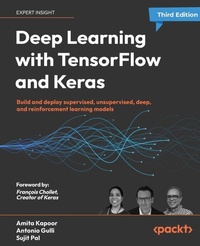
Deep Learning with TensorFlow and Keras
Build and deploy supervised, unsupervised, deep, and reinforcement learning models
3rd Edition
Published on 4. November 2022
Book
Paperback/Softback
698 pages
978-1-80323-291-1 (ISBN)
Description
Build cutting edge machine and deep learning systems for the lab, production, and mobile devices.
Purchase of the print or Kindle book includes a free eBook in PDF format.
Key Features
Understand the fundamentals of deep learning and machine learning through clear explanations and extensive code samples
Implement graph neural networks, transformers using Hugging Face and TensorFlow Hub, and joint and contrastive learning
Learn cutting-edge machine and deep learning techniques
Book DescriptionDeep Learning with TensorFlow and Keras teaches you neural networks and deep learning techniques using TensorFlow (TF) and Keras. You'll learn how to write deep learning applications in the most powerful, popular, and scalable machine learning stack available.
TensorFlow 2.x focuses on simplicity and ease of use, with updates like eager execution, intuitive higher-level APIs based on Keras, and flexible model building on any platform. This book uses the latest TF 2.0 features and libraries to present an overview of supervised and unsupervised machine learning models and provides a comprehensive analysis of deep learning and reinforcement learning models using practical examples for the cloud, mobile, and large production environments.
This book also shows you how to create neural networks with TensorFlow, runs through popular algorithms (regression, convolutional neural networks (CNNs), transformers, generative adversarial networks (GANs), recurrent neural networks (RNNs), natural language processing (NLP), and graph neural networks (GNNs)), covers working example apps, and then dives into TF in production, TF mobile, and TensorFlow with AutoML.
What you will learn
Learn how to use the popular GNNs with TensorFlow to carry out graph mining tasks
Discover the world of transformers, from pretraining to fine-tuning to evaluating them
Apply self-supervised learning to natural language processing, computer vision, and audio signal processing
Combine probabilistic and deep learning models using TensorFlow Probability
Train your models on the cloud and put TF to work in real environments
Build machine learning and deep learning systems with TensorFlow 2.x and the Keras API
Who this book is forThis hands-on machine learning book is for Python developers and data scientists who want to build machine learning and deep learning systems with TensorFlow. This book gives you the theory and practice required to use Keras, TensorFlow, and AutoML to build machine learning systems.
Some machine learning knowledge would be useful. We don't assume TF knowledge.
Purchase of the print or Kindle book includes a free eBook in PDF format.
Key Features
Understand the fundamentals of deep learning and machine learning through clear explanations and extensive code samples
Implement graph neural networks, transformers using Hugging Face and TensorFlow Hub, and joint and contrastive learning
Learn cutting-edge machine and deep learning techniques
Book DescriptionDeep Learning with TensorFlow and Keras teaches you neural networks and deep learning techniques using TensorFlow (TF) and Keras. You'll learn how to write deep learning applications in the most powerful, popular, and scalable machine learning stack available.
TensorFlow 2.x focuses on simplicity and ease of use, with updates like eager execution, intuitive higher-level APIs based on Keras, and flexible model building on any platform. This book uses the latest TF 2.0 features and libraries to present an overview of supervised and unsupervised machine learning models and provides a comprehensive analysis of deep learning and reinforcement learning models using practical examples for the cloud, mobile, and large production environments.
This book also shows you how to create neural networks with TensorFlow, runs through popular algorithms (regression, convolutional neural networks (CNNs), transformers, generative adversarial networks (GANs), recurrent neural networks (RNNs), natural language processing (NLP), and graph neural networks (GNNs)), covers working example apps, and then dives into TF in production, TF mobile, and TensorFlow with AutoML.
What you will learn
Learn how to use the popular GNNs with TensorFlow to carry out graph mining tasks
Discover the world of transformers, from pretraining to fine-tuning to evaluating them
Apply self-supervised learning to natural language processing, computer vision, and audio signal processing
Combine probabilistic and deep learning models using TensorFlow Probability
Train your models on the cloud and put TF to work in real environments
Build machine learning and deep learning systems with TensorFlow 2.x and the Keras API
Who this book is forThis hands-on machine learning book is for Python developers and data scientists who want to build machine learning and deep learning systems with TensorFlow. This book gives you the theory and practice required to use Keras, TensorFlow, and AutoML to build machine learning systems.
Some machine learning knowledge would be useful. We don't assume TF knowledge.
More details
Edition
3rd Revised edition
Language
English
Place of publication
Birmingham
United Kingdom
Target group
US School Grade: College Graduate Student
Edition type
Revised edition
Dimensions
Height: 235 mm
Width: 191 mm
Thickness: 38 mm
Weight
1280 gr
ISBN-13
978-1-80323-291-1 (9781803232911)
Copyright in bibliographic data and cover images is held by Nielsen Book Services Limited or by the publishers or by their respective licensors: all rights reserved.
Schweitzer Classification
Persons
Dr. Amita Kapoor is an accomplished AI consultant and educator with over 25 years of experience. She has received international recognition for her work, including the DAAD Fellowship and the Intel Developer Mesh AI Innovator Award. She is a highly respected scholar in her field, with over 100 research papers and several best-selling books on deep learning and AI. As an Associate Professor at the University of Delhi and a member of the Board of Directors for the non-profit Neuromatch Academy, Amita is dedicated to democratizing AI education. As the founder of NePeur, she provides data analytics and AI consultancy services to. Additionally, she teaches online classes on data science and AI at the University of Oxford.
Antonio Gulli has a passion for establishing and managing global technological talent for innovation and execution. His core expertise is in cloud computing, deep learning, and search engines. Currently, Antonio works for Google in the Cloud Office of the CTO in Zurich, working on Search, Cloud Infra, Sovereignty, and Conversational AI.
Sujit Pal is a Technology Research Director at Elsevier Labs, an advanced technology group within the Reed-Elsevier Group of companies. His interests include semantic search, natural language processing, machine learning, and deep learning. At Elsevier, he has worked on several initiatives involving search quality measurement and improvement, image classification and duplicate detection, and annotation and ontology development for medical and scientific corpora.
Antonio Gulli has a passion for establishing and managing global technological talent for innovation and execution. His core expertise is in cloud computing, deep learning, and search engines. Currently, Antonio works for Google in the Cloud Office of the CTO in Zurich, working on Search, Cloud Infra, Sovereignty, and Conversational AI.
Sujit Pal is a Technology Research Director at Elsevier Labs, an advanced technology group within the Reed-Elsevier Group of companies. His interests include semantic search, natural language processing, machine learning, and deep learning. At Elsevier, he has worked on several initiatives involving search quality measurement and improvement, image classification and duplicate detection, and annotation and ontology development for medical and scientific corpora.
Content
Table of Contents
Neural Networks Foundations with TF
Regression and Classification
Convolutional Neural Networks
Word Embeddings
Recurrent Neural Network
Transformers
Unsupervised Learning
Autoencoders
Generative Models
Self-Supervised Learning
Reinforcement Learning
Probabilistic TensorFlow
An Introduction to AutoML
The Math Behind Deep Learning
Tensor Processing Unit
Other Useful Deep Learning Libraries
Graph Neural Networks
Machine Learning Best Practices
TensorFlow 2 Ecosystem
Advanced Convolutional Neural Networks
Neural Networks Foundations with TF
Regression and Classification
Convolutional Neural Networks
Word Embeddings
Recurrent Neural Network
Transformers
Unsupervised Learning
Autoencoders
Generative Models
Self-Supervised Learning
Reinforcement Learning
Probabilistic TensorFlow
An Introduction to AutoML
The Math Behind Deep Learning
Tensor Processing Unit
Other Useful Deep Learning Libraries
Graph Neural Networks
Machine Learning Best Practices
TensorFlow 2 Ecosystem
Advanced Convolutional Neural Networks