

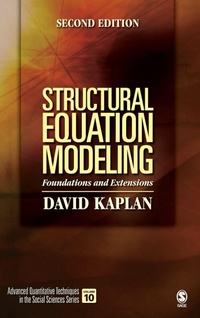
Structural Equation Modeling
Foundations and Extensions
2nd Edition
Published on 4. September 2008
Book
Hardback
272 pages
978-1-4129-1624-0 (ISBN)
Description
Using detailed, empirical examples, Structural Equation Modeling, Second Edition, presents a thorough and sophisticated treatment of the foundations of structural equation modeling (SEM). It also demonstrates how SEM can provide a unique lens on the problems social and behavioral scientists face.
Intended Audience
While the book assumes some knowledge and background in statistics, it guides readers through the foundations and critical assumptions of SEM in an easy-to-understand manner.
Intended Audience
While the book assumes some knowledge and background in statistics, it guides readers through the foundations and critical assumptions of SEM in an easy-to-understand manner.
More details
Series
Edition
2nd Revised edition
Language
English
Place of publication
Thousand Oaks
United States
Target group
College/higher education
Edition type
Revised edition
Dimensions
Height: 235 mm
Width: 157 mm
Thickness: 19 mm
Weight
549 gr
ISBN-13
978-1-4129-1624-0 (9781412916240)
Copyright in bibliographic data and cover images is held by Nielsen Book Services Limited or by the publishers or by their respective licensors: all rights reserved.
Schweitzer Classification
Other editions
Previous edition
Book
11/2000
1st Edition
SAGE Publications Inc
€70.84
Article exhausted; check for reprint
Person
David Kaplan received his Ph.D. in Education from UCLA in 1987. He is now a Professor of Education and (by courtesy) Psychology at the University of Delaware. His research interests are in the development and application of statistical models to problems in educational evaluation and policy analysis. His current program of research concerns the development of dynamic latent continuous and categorical variable models for studying the diffusion of educational innovations.
Content
Preface to the Second Edition
1. Historical Foundations of Structural Equation Modeling for Continuous and Categorical Latent Variables
2. Path Analysis: Modeling Systems of Structural Equations Among Observed Variables
3. Factor Analysis
4. Structural Equation Models in Single and Multiple Groups
5. Statistical Assumptions Underlying Structural Equation Modeling
6. Evaluating and Modifying Structural Equation Models
7. Multilevel Structural Equation Modeling
8. Latent Growth Curve Modeling
9. Structural Models for Categorical and Continuous Latent Variables
10. Epilogue: Toward a New Approach to the Practice of Structural Equation Modeling
1. Historical Foundations of Structural Equation Modeling for Continuous and Categorical Latent Variables
2. Path Analysis: Modeling Systems of Structural Equations Among Observed Variables
3. Factor Analysis
4. Structural Equation Models in Single and Multiple Groups
5. Statistical Assumptions Underlying Structural Equation Modeling
6. Evaluating and Modifying Structural Equation Models
7. Multilevel Structural Equation Modeling
8. Latent Growth Curve Modeling
9. Structural Models for Categorical and Continuous Latent Variables
10. Epilogue: Toward a New Approach to the Practice of Structural Equation Modeling