

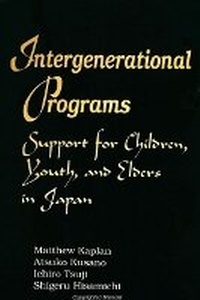
Intergenerational Programs
Support for Children, Youth, and Elders in Japan
Published on 29. January 1998
Book
Hardback
267 pages
978-0-7914-3667-7 (ISBN)
Description
Provides a rarely-seen portrait of intergenerational programs in Japan, including an overview of similar programs in the United States, of growing interest as our population ages.
The "intergenerational programming concept," now garnering increased interest in America, has been applied to Japanese society as a strategy for maintaining intergenerational and cultural continuity in the face of social and demographic changes. While Japan is known for its enduring and resilient family structure which provides support for people of all ages, the country's growing aged population, combined with a trend away from three-generation families and changing social values, exposes a need for new mechanisms beyond the family to promote intergenerational communication, support, and cultural continuity.
The authors identify a rich geographically diverse set of intergenerational programs and activities that serve a wide range of human and community development objectives. Beyond promoting intergenerational understanding among participants, these initiatives function to help people to pursue their educational objectives, arts and recreation interests, desired states of health and welfare, environmental preservation and community development goals, and religious and spiritual well-being. Intergenerational endeavors constitute an integral approach for supplementing familial support systems and maintaining social cohesion in Japan as it enters the twenty-first century.
The "intergenerational programming concept," now garnering increased interest in America, has been applied to Japanese society as a strategy for maintaining intergenerational and cultural continuity in the face of social and demographic changes. While Japan is known for its enduring and resilient family structure which provides support for people of all ages, the country's growing aged population, combined with a trend away from three-generation families and changing social values, exposes a need for new mechanisms beyond the family to promote intergenerational communication, support, and cultural continuity.
The authors identify a rich geographically diverse set of intergenerational programs and activities that serve a wide range of human and community development objectives. Beyond promoting intergenerational understanding among participants, these initiatives function to help people to pursue their educational objectives, arts and recreation interests, desired states of health and welfare, environmental preservation and community development goals, and religious and spiritual well-being. Intergenerational endeavors constitute an integral approach for supplementing familial support systems and maintaining social cohesion in Japan as it enters the twenty-first century.
Reviews / Votes
"There are flashes in this book that illuminate the profound differences between a traditional homogenous society like Japan and a relatively new, non-homogenous society like the United States. Reading about intergenerational issues in Japan allowed me to gain a deeper understanding of the similarities and differences between U.S. and Japanese culture." - Robert Disch, Hunter College, City University of New YorkMore details
Series
Language
English
Place of publication
Albany, NY
United States
Target group
College/higher education
Professional and scholarly
US School Grade: College Graduate Student and over
Weight
535 gr
ISBN-13
978-0-7914-3667-7 (9780791436677)
Copyright in bibliographic data and cover images is held by Nielsen Book Services Limited or by the publishers or by their respective licensors: all rights reserved.
Schweitzer Classification
Persons
Matthew Kaplan is Associate Professor of Psychology at Hawaii Pacific University and author of Side by Side: Exploring Your Neighborhood Through Intergenerational Activities. Atsuko Kusano is Associate Professor at Shinshu University. At Tohoku University School of Medicine, Ichiro Tsuji is Associate Professor of Public Health.
Content
Preface
Acknowledgments
Chapter 1. Introduction
Chapter 2. The Changing Nature of Childhood, Youth, and Old Age in Japan
Chapter 3. The Conceptual and Organizational Roots of Japan's Intergenerational Initiatives
Chapter 4. School-based Initiatives
Chapter 5. Community-based Programs, Events, and Activities
Chapter 6. Other Frameworks for Promoting Intergenerational Discourse
Chapter 7. Conclusions
Chapter 8. Discussion
Chapter 9. Recommendations
Chapter 10. Closing Comments
Appendices
Notes
References
Contributors
Index
Acknowledgments
Chapter 1. Introduction
Chapter 2. The Changing Nature of Childhood, Youth, and Old Age in Japan
Chapter 3. The Conceptual and Organizational Roots of Japan's Intergenerational Initiatives
Chapter 4. School-based Initiatives
Chapter 5. Community-based Programs, Events, and Activities
Chapter 6. Other Frameworks for Promoting Intergenerational Discourse
Chapter 7. Conclusions
Chapter 8. Discussion
Chapter 9. Recommendations
Chapter 10. Closing Comments
Appendices
Notes
References
Contributors
Index