

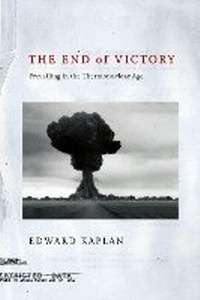
The End of Victory
Prevailing in the Thermonuclear Age
Published on 15. November 2022
Book
Hardback
280 pages
978-1-5017-6612-1 (ISBN)
Description
The End of Victory recounts the costs of failure in nuclear war through the work of the most secret deliberative body of the National Security Council, the Net Evaluation Subcommittee (NESC). From 1953 onward, US leaders wanted to know as precisely as possible what would happen if they failed in a nuclear war-how many Americans would die and how much of the country would remain. The NESC told Presidents Dwight Eisenhower and John F. Kennedy what would be the result of the worst failure of American strategy-a maximum-effort surprise Soviet nuclear assault on the United States.
Edward Kaplan details how NESC studies provided key information for presidential decisions on the objectives of a war with the USSR and on the size and shape of the US military. The subcommittee delivered its annual reports in a decade marked by crises in Berlin, Quemoy and Matsu, Laos, and Cuba, among others. During these critical moments and day-to-day containment of the USSR, the NESC's reports offered the best estimates of the butcher's bill of conflict and of how to reduce the cost in American lives.
Taken with the intelligence community's assessment of the probability of a surprise attack, the NESC's work framed the risks of US strategy in the chilliest years of the Cold War. The End of Victory reveals how all policy decisions run risks-and ones involving military force run grave ones-though they can rarely be known with precision.
Edward Kaplan details how NESC studies provided key information for presidential decisions on the objectives of a war with the USSR and on the size and shape of the US military. The subcommittee delivered its annual reports in a decade marked by crises in Berlin, Quemoy and Matsu, Laos, and Cuba, among others. During these critical moments and day-to-day containment of the USSR, the NESC's reports offered the best estimates of the butcher's bill of conflict and of how to reduce the cost in American lives.
Taken with the intelligence community's assessment of the probability of a surprise attack, the NESC's work framed the risks of US strategy in the chilliest years of the Cold War. The End of Victory reveals how all policy decisions run risks-and ones involving military force run grave ones-though they can rarely be known with precision.
Reviews / Votes
Kaplan, dean of the School of Strategic Landpower at the US Army War College, explains in this thought-provoking book how the meaning of victory in the postwar era was transformed. For US presidents from Eisenhower to Kennedy, the significance of victory was reassessed because of the work of a little-known subcommittee of the National Security Council called the Net Evaluation Subcommittee.(Choice)
More details
Language
English
Place of publication
Ithaca
United States
Product notice
Paper over boards
Dimensions
Height: 229 mm
Width: 152 mm
Thickness: 25 mm
Weight
907 gr
ISBN-13
978-1-5017-6612-1 (9781501766121)
Copyright in bibliographic data and cover images is held by Nielsen Book Services Limited or by the publishers or by their respective licensors: all rights reserved.
Schweitzer Classification
Other editions
Additional editions
E-Book
11/2022
Cornell University Press
€31.49
Available for download
Person
Edward Kaplan is the Dean of the School of Strategic Landpower at the US Army War College in Carlisle, Pennsylvania. He is the author of To Kill Nations.
Content
Introduction
1. Origins
2. Victory
3. Victory's Twilight
4. Prevailing in the Space Age
5. Finding the Optimum-Mix
6. From Forcible Action to Coercion
7. Testing Controlled Response
8. War Termination and NESC's End
Conclusion
1. Origins
2. Victory
3. Victory's Twilight
4. Prevailing in the Space Age
5. Finding the Optimum-Mix
6. From Forcible Action to Coercion
7. Testing Controlled Response
8. War Termination and NESC's End
Conclusion