

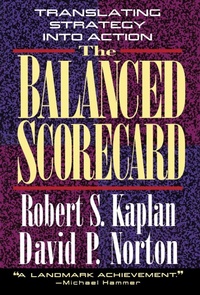
The Balanced Scorecard
Translating Strategy into Action
Published on 1. September 1996
Book
Hardback
336 pages
978-0-87584-651-4 (ISBN)
Description
The Balanced Scorecard translates a company's vision and strategy into a coherent set of performance measures. The four perspectives of the scorecard--financial measures, customer knowledge, internal business processes, and learning and growth--offer a balance between short-term and long-term objectives, between outcomes desired and performance drivers of those outcomes, and between hard objective measures and softer, more subjective measures. In the first part, Kaplan and Norton provide the theoretical foundations for the Balanced Scorecard; in the second part, they describe the steps organizations must take to build their own Scorecards; and, finally, they discuss how the Balanced Scorecard can be used as a driver of change.
More details
Language
English
Place of publication
United States
Target group
Professional and scholarly
Product notice
Cloth over boards
Illustrations
Illustrations
Dimensions
Height: 244 mm
Width: 166 mm
Thickness: 29 mm
Weight
649 gr
ISBN-13
978-0-87584-651-4 (9780875846514)
Copyright in bibliographic data and cover images is held by Nielsen Book Services Limited or by the publishers or by their respective licensors: all rights reserved.
Schweitzer Classification
Other editions
Additional editions
E-Book
08/1996
1st Edition
Harvard Business Review Press
€43.99
Available for download
Persons
Robert S. Kaplan is the Arthur Lowes Dickinson Professor of Accounting at the Harvard Business School. David P. Norton is the president of Renaissance Solutions, Inc. They are the authors of three seminal Harvard Business Review articles on the Balanced Scorecard.
Content
Preface 1. Measurement and Management in the Information Age 2. Why Does Business Need a Balanced Scorecard? Part One-Measuring Business Strategy 3. Financial Perspective 4. Customer Perspective 5. Internal-Business-Process Perspective 6. Learning and Growth Perspective 7. Linking Balanced Scorecard Measures to Your Strategy 8. Structure and Strategy Part Two-Managing Business Strategy 9. Achieving Strategic Alignment: From Top to Bottom 10. Targets, Resource Allocation, Initiatives, and Budgets 11. Feedback and the Strategic Learning Process 12. Implementing a Balanced Scorecard Management Program Appendix: Building a Balanced Scorecard Index About the Authors