

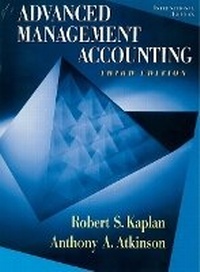
Advanced Management Accounting
International Edition
3rd Edition
Published on 9. February 1998
Book
Paperback/Softback
816 pages
978-0-13-080220-0 (ISBN)
Description
Suitable for upper level advanced management or cost accounting courses at the undergraduate or MBA/graduate level. Assumes knowledge of management and/or cost accounting.
This text provides leading-edge treatment of innovative management accounting issues used by major companies throughout the world. Takes a systematic management- oriented approach to advanced management topics. Each chapter is accompanied by cases to illustrate the concepts discussed.
This text provides leading-edge treatment of innovative management accounting issues used by major companies throughout the world. Takes a systematic management- oriented approach to advanced management topics. Each chapter is accompanied by cases to illustrate the concepts discussed.
More details
Edition
3rd edition
Language
English
Place of publication
United States
Publishing group
Pearson Education (US)
Target group
Professional and scholarly
Dimensions
Height: 233 mm
Width: 178 mm
Thickness: 36 mm
Weight
1060 gr
ISBN-13
978-0-13-080220-0 (9780130802200)
Copyright in bibliographic data and cover images is held by Nielsen Book Services Limited or by the publishers or by their respective licensors: all rights reserved.
Schweitzer Classification
Other editions
New editions
Robert Kaplan | Robert S. Kaplan | Anthony A. Atkinson
Advanced Management Accounting
Pearson New International Edition
Book
08/2013
3rd Edition
Pearson Education Limited
€99.49
Shipment within 10-20 days
Previous edition

Robert Steven Kaplan | Anthony A. Atkinson
Advanced Management Accounting
Book
04/1989
2nd Edition
Prentice-Hall
€37.08
Article exhausted; check for reprint
Content
1. Cost System Concepts. Resources and Activities. Committed and Flexible Costs. Costs of Resource Supply and Resource Usage.
2. Decision Making with Committed and Flexible Resources. Choosing an Optimal Product Mix. Short Term Budgeting.
3. Assigning Support and Service Department Costs. Service Department Costs.
4. Activity-Based Costing. Assigning Resource Costs To Activities. Activity Cost Drivers: Selection and Use. Cost Hierarchy (Unit, Batch, Product, and Customer-Sustaining).
5. Decision-Making about Products. Measuring Product Profitability. Pricing. Other Product-Related Decisions: Substitution, Customers.
6. Cost-Based Decision Making. Activity Management and Process Improvement. Kaizen. Life Cycle Costing. Target Costing.
7. Decentralization.
8. Balanced Scorecard: Measuring Total Business Unit Performance.
9. Financial Measures of Performance. Profit Centers/Transfer Pricing. Variance Analysis. Productivity Measures.
10. Financial Measures of Performance: Investments and EVA.
11. Measuring Performance from Customer and Internal Business Process Perspective. Total Quality and Continuous Improvement. Cost of Quality. Cycle Time Management. Other Customer and Internal Business Process Measures, Including Product Development and Innovation.
12. Investing to Develop Future Capabilities. Investments in Technology Linked to Customer Satisfaction, Process Improvements, Internal Capabilities, Reengineering.
13. Incentive and Compensation Systems. Incorporate New Material On Incentive Systems. Summarize Agency Material. Summarize Emerging Material On Compensation and Nonfinancial Performance.
14. Formal Models for Budgeting and Control Systems. Measures. Summarize Agency Material.
2. Decision Making with Committed and Flexible Resources. Choosing an Optimal Product Mix. Short Term Budgeting.
3. Assigning Support and Service Department Costs. Service Department Costs.
4. Activity-Based Costing. Assigning Resource Costs To Activities. Activity Cost Drivers: Selection and Use. Cost Hierarchy (Unit, Batch, Product, and Customer-Sustaining).
5. Decision-Making about Products. Measuring Product Profitability. Pricing. Other Product-Related Decisions: Substitution, Customers.
6. Cost-Based Decision Making. Activity Management and Process Improvement. Kaizen. Life Cycle Costing. Target Costing.
7. Decentralization.
8. Balanced Scorecard: Measuring Total Business Unit Performance.
9. Financial Measures of Performance. Profit Centers/Transfer Pricing. Variance Analysis. Productivity Measures.
10. Financial Measures of Performance: Investments and EVA.
11. Measuring Performance from Customer and Internal Business Process Perspective. Total Quality and Continuous Improvement. Cost of Quality. Cycle Time Management. Other Customer and Internal Business Process Measures, Including Product Development and Innovation.
12. Investing to Develop Future Capabilities. Investments in Technology Linked to Customer Satisfaction, Process Improvements, Internal Capabilities, Reengineering.
13. Incentive and Compensation Systems. Incorporate New Material On Incentive Systems. Summarize Agency Material. Summarize Emerging Material On Compensation and Nonfinancial Performance.
14. Formal Models for Budgeting and Control Systems. Measures. Summarize Agency Material.