

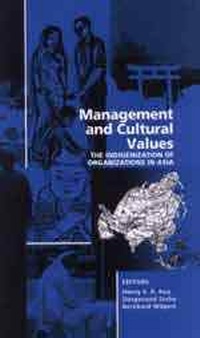
Management and Cultural Values
The Indiginization of Organizations in Asia
1st Edition
Published on 5. August 1999
Book
Paperback/Softback
332 pages
978-0-7619-9319-3 (ISBN)
Description
Management and Cultural Values examines the influence of (culturally derived) social values on indigenous management practices and work activities.
The authors focus on Asian organizations which exemplify the successful blending of traditional social values, attitudes and institutional norms with the demands of techno-economic systems.
The authors focus on Asian organizations which exemplify the successful blending of traditional social values, attitudes and institutional norms with the demands of techno-economic systems.
More details
Edition
First Edition
Language
English
Place of publication
Thousand Oaks
United States
Target group
Professional and scholarly
Weight
300 gr
ISBN-13
978-0-7619-9319-3 (9780761993193)
Copyright in bibliographic data and cover images is held by Nielsen Book Services Limited or by the publishers or by their respective licensors: all rights reserved.
Schweitzer Classification
Persons
Durganand Sinha (Born: 23 September 1922; Died: 23 March 1998) did his B.A. and M.A. in Philosophy (with specialization in Psychology) from Patna University. Subsequently, he went to Cambridge University where he was awarded the M.Sc. degree. On his return to India in 1949, Professor Sinha joined as the faculty of Psychology at Patna University. His research article 'Behavior in a catastrophic situation: A psychological study of reports and rumors' published in the British Journal of Psychology showed his scientific creativity and responsiveness to the problems of his immediate surroundings. He left Patna in 1958 and joined the newly established Indian Institute of Technology, Kharagpur.Professor Sinha came to Allahabad University in 1961 as a professor to chair the newly created Department of Psychology. In the mid-1980s, he also served as the Director of the A.N. Sinha Institute of Social Studies, Patna. The present status of the Department of Psychology at Allahabad as a Centre of Advanced Study owes much to his vision and dedication.
In a career spanning half a century, Professor Sinha made significant contributions as a researcher in diverse areas. It encompassed the role of socio-cultural factors in perception and cognition; changes in the Indian family and the implications for the socialization process; larger applied social psychological issues such as motivation and rural development, deprivation and poverty; and social change. His books (listed in the section 'Complete Works of Durganand Sinha' in this volume) have left his name permanently in the field of psychology of social sciences. In India, he was a central figure of the psychological profession. He served as the President of the Indian Psychological Association, the Indian Academy of Applied Psychology and Psychology Section of the Indian Science Congress.
In a career spanning half a century, Professor Sinha made significant contributions as a researcher in diverse areas. It encompassed the role of socio-cultural factors in perception and cognition; changes in the Indian family and the implications for the socialization process; larger applied social psychological issues such as motivation and rural development, deprivation and poverty; and social change. His books (listed in the section 'Complete Works of Durganand Sinha' in this volume) have left his name permanently in the field of psychology of social sciences. In India, he was a central figure of the psychological profession. He served as the President of the Indian Psychological Association, the Indian Academy of Applied Psychology and Psychology Section of the Indian Science Congress.
Content
Introduction - Durganand Sinha, Henry S R Kao and Bernhard Wilpert
The Emergence of Indigenization
PART ONE: CONCEPTUAL ISSUES
Leadership Styles and Management - Bernhard Wilpert
Universally Convergent or Culture Bound?
Approaches to Indigenous Management - Durganand Sinha
Entrepreneurship Development - Suresh Balakrishnan, K Gopakumar and Rabindra N Kanungo
Concept and Context
PART TWO: WORK CULTURE
`Bushido' - John Fukuda
The Guiding Principle of New Japan
Determinants and Characteristics of the Corporate Culture of Korean Enterprises - Son-Ung Kim
The Truly Familial Work-Organziation - Rajen K Gupta
Extending the Organizational Boundary to Include Employees' Families in the Indian Context
Japanese and Indian Work Patterns - Anshuman Khare
A Study of Contrasts
PART THREE: VALUES AND ORGANIZATIONS
The Evolution of Work Ethic and Management Thought - Abbas J Ali
An Islamic View
The Concept of Bao and Its Significance in Organizational Research - Chaoming Liu
Employees' Perception of Distributive Fairness in the People's Republic of China - Yu Kai-cheng and He Wei
Value Clarification for a Synergetic Work Culture in Organizations - Mala Sinha
Social Values in Organizations - S K Chakraborty
The Case for Countervailing Socialization
PART FOUR: INDIGENOUS FACTORS IN MANAGERIAL LEADERSHIP
Corporate Statemanship - Ng Sek Hong and Henry S R Kao
A Cursory Note and Implications
Chinese Chief Executive Officers' Employee Categorization and Managerial Behaviour - Borshiuan Cheng
The Role of Chin-Shins of Top Managers in Taiwanese Organizations - Shu-Cheng Chi
Exploring Chinese Leadership Phenomena
The Thai Concept of Effective Leadership - Suntaree Komin
Some Behavioural Dimensions of Effective Managerial Style in the Indian Context - Satish Kumar Kalra and Rajen K Gupta
The Emergence of Indigenization
PART ONE: CONCEPTUAL ISSUES
Leadership Styles and Management - Bernhard Wilpert
Universally Convergent or Culture Bound?
Approaches to Indigenous Management - Durganand Sinha
Entrepreneurship Development - Suresh Balakrishnan, K Gopakumar and Rabindra N Kanungo
Concept and Context
PART TWO: WORK CULTURE
`Bushido' - John Fukuda
The Guiding Principle of New Japan
Determinants and Characteristics of the Corporate Culture of Korean Enterprises - Son-Ung Kim
The Truly Familial Work-Organziation - Rajen K Gupta
Extending the Organizational Boundary to Include Employees' Families in the Indian Context
Japanese and Indian Work Patterns - Anshuman Khare
A Study of Contrasts
PART THREE: VALUES AND ORGANIZATIONS
The Evolution of Work Ethic and Management Thought - Abbas J Ali
An Islamic View
The Concept of Bao and Its Significance in Organizational Research - Chaoming Liu
Employees' Perception of Distributive Fairness in the People's Republic of China - Yu Kai-cheng and He Wei
Value Clarification for a Synergetic Work Culture in Organizations - Mala Sinha
Social Values in Organizations - S K Chakraborty
The Case for Countervailing Socialization
PART FOUR: INDIGENOUS FACTORS IN MANAGERIAL LEADERSHIP
Corporate Statemanship - Ng Sek Hong and Henry S R Kao
A Cursory Note and Implications
Chinese Chief Executive Officers' Employee Categorization and Managerial Behaviour - Borshiuan Cheng
The Role of Chin-Shins of Top Managers in Taiwanese Organizations - Shu-Cheng Chi
Exploring Chinese Leadership Phenomena
The Thai Concept of Effective Leadership - Suntaree Komin
Some Behavioural Dimensions of Effective Managerial Style in the Indian Context - Satish Kumar Kalra and Rajen K Gupta