

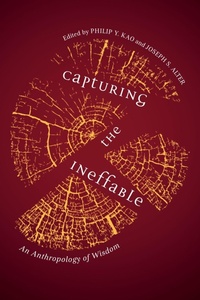
Capturing the Ineffable
An Anthropology of Wisdom
Published on 18. May 2020
Book
Hardback
264 pages
978-1-4875-0313-0 (ISBN)
Description
Grounded in ethnographic case studies that examine experiences from which wisdom emerges, Capturing the Ineffable provides a rigorous analysis of the sociocultural context of wisdom in the contemporary world. Each chapter in the volume deals with different aspects and showcases how communities in different contexts - nursing homes, religious organizations, corporations, and monastic institutions, for example - engage with the ineffability of wisdom.
Contributors draw from a range of disciplines and cross-cultural and historical data in order to interpret the meaning and value of wisdom as a human endeavour. This book also represents an anthropological method for evaluating various philosophical and scientific approaches to understanding wisdom, including how wisdom is learned and taught. Readers will be able to appreciate how action, emotion, uncertainty, and cultural systems come to bear on wisdom as a value in human life and expression. In the end, Capturing the Ineffable reveals how the conception and paradoxical nature of wisdom dispels the dichotomies of self/other, structure/agency, known/unknown, nature/culture, and the like. What is at stake is a recasting of wisdom as a particular kind of anthropological endeavour and, thus, a return to and modification of philosophical anthropology.
Contributors draw from a range of disciplines and cross-cultural and historical data in order to interpret the meaning and value of wisdom as a human endeavour. This book also represents an anthropological method for evaluating various philosophical and scientific approaches to understanding wisdom, including how wisdom is learned and taught. Readers will be able to appreciate how action, emotion, uncertainty, and cultural systems come to bear on wisdom as a value in human life and expression. In the end, Capturing the Ineffable reveals how the conception and paradoxical nature of wisdom dispels the dichotomies of self/other, structure/agency, known/unknown, nature/culture, and the like. What is at stake is a recasting of wisdom as a particular kind of anthropological endeavour and, thus, a return to and modification of philosophical anthropology.
More details
Language
English
Place of publication
Toronto
Canada
Target group
College/higher education
Professional and scholarly
Product notice
sewn/stitched
Cloth over boards
With dust jacket
Illustrations
2 figures
Dimensions
Height: 231 mm
Width: 163 mm
Thickness: 23 mm
Weight
544 gr
ISBN-13
978-1-4875-0313-0 (9781487503130)
Copyright in bibliographic data and cover images is held by Nielsen Book Services Limited or by the publishers or by their respective licensors: all rights reserved.
Schweitzer Classification
Persons
Philip Y. Kao is a research associate in the Department of Anthropology at the University of Pittsburgh.
Joseph S. Alter is the director of the Asian Studies Center and a professor of anthropology at the University of Pittsburgh.
Joseph S. Alter is the director of the Asian Studies Center and a professor of anthropology at the University of Pittsburgh.
Content
Introduction: Toward an Anthropology of Wisdom
Philip Kao, University of Pittsburgh
Part I. Seeking Wisdom
Revelations of Delusion: Becoming Isomorphic to the Ugrund, Richard Doyle, Penn State
The Social Life of the Inexpressible: English Benedictine Mysticism, the Ineffable, and the Sublime, Richard Irvine, University of St Andrews
Part II. Discerning Wisdom
How Wisdom in Discovered: Discretion and Emotional Insights in Naikan Meditation in Japan, Clark Chilson, University of Pittsburgh
Navigating Wisdom and Time in the Context of Aging and Eldercare, Philip Kao, University of Pittsburgh
Part III. Transmitting Wisdom
Yoga and Wisdom: Reflections on the Body at the Intersection of Epistemology and Ontology, Joseph Alter, University of Pittsburgh
The Social Construction of Wisdom in Institutions, Charlotte Linde
Part IV. Narrating Wisdom
Of Uncertainty, Sophiology and Contemporary Governance: Zen and the Art of Scenario Planning, James Faubion, Rice University
Grappling with the Ineffable in Three African Situations: An Ethnographic Approach, Wim van Binsbergen, African Studies Centre, Leiden
Philip Kao, University of Pittsburgh
Part I. Seeking Wisdom
Revelations of Delusion: Becoming Isomorphic to the Ugrund, Richard Doyle, Penn State
The Social Life of the Inexpressible: English Benedictine Mysticism, the Ineffable, and the Sublime, Richard Irvine, University of St Andrews
Part II. Discerning Wisdom
How Wisdom in Discovered: Discretion and Emotional Insights in Naikan Meditation in Japan, Clark Chilson, University of Pittsburgh
Navigating Wisdom and Time in the Context of Aging and Eldercare, Philip Kao, University of Pittsburgh
Part III. Transmitting Wisdom
Yoga and Wisdom: Reflections on the Body at the Intersection of Epistemology and Ontology, Joseph Alter, University of Pittsburgh
The Social Construction of Wisdom in Institutions, Charlotte Linde
Part IV. Narrating Wisdom
Of Uncertainty, Sophiology and Contemporary Governance: Zen and the Art of Scenario Planning, James Faubion, Rice University
Grappling with the Ineffable in Three African Situations: An Ethnographic Approach, Wim van Binsbergen, African Studies Centre, Leiden