

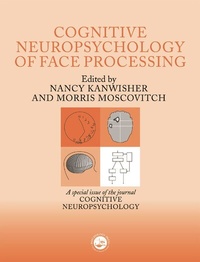
The Cognitive Neuroscience of Face Processing
A Special Issue of Cognitive Neuropsychology
1st Edition
Published on 25. May 2000
Book
Hardback
304 pages
978-0-86377-614-4 (ISBN)
Description
For social primates like us, faces may be the most biologically significant stimuli we view. Faces provide information not only about identity but also about mood, age, sex, and direction of overt attention. Does our ability to extract this information from faces rely on special-purpose cognitive and neural mechanisms distinct from those involved in the perception of other classes of visual stimuli? If so, how do those mechanisms work? Do these mechanisms arise from experience alone, or is there an innate predisposition to create them? How is face recognition affected by development and aging? What is the relation between face recognition and other cognitive functions such as memory and attention and the neural substrates that mediate them?
This special issue showcases new findings from many investigators in this field who address these fundamental questions in studies that use a wide range of experimental techniques including brain imaging, ERPs, patient studies, and single-unit recording in monkeys.
This special issue showcases new findings from many investigators in this field who address these fundamental questions in studies that use a wide range of experimental techniques including brain imaging, ERPs, patient studies, and single-unit recording in monkeys.
More details
Series
Language
English
Place of publication
Hove
United Kingdom
Publishing group
Taylor & Francis Ltd
Target group
College/higher education
Professional and scholarly
Dimensions
Height: 246 mm
Width: 189 mm
Weight
720 gr
ISBN-13
978-0-86377-614-4 (9780863776144)
Copyright in bibliographic data and cover images is held by Nielsen Book Services Limited or by the publishers or by their respective licensors: all rights reserved.
Schweitzer Classification
Other editions
Additional editions
Nancy Kanwisher | Morris Moscovitch
The Cognitive Neuroscience of Face Processing
A Special Issue of Cognitive Neuropsychology
Book
05/2015
1st Edition
Psychology Press Ltd
€84.36
Shipment within 10-20 days
Persons
Nancy Kanwisher, Morris Moscovitch
Content
Kanwisher, Moscovitch, The Cognitive Neuroscience of Face Processing: An Introduction. Ashbridge, Perrett, Oram, Jellema, Effect of Image Orientation and Size on Object Recognition: Responses of Single Units in the Macaque Monkey Temporal Cortex. Bentin, Deouell, Structural Encoding and Identification in Face Processing: ERP Evidence for Separate Mechanisms. Breen, Caine, Coltheart, Models of Face Recognition and Delusional Misidentification: A Critical Review. Calder, Keane, Cole, Campbell, Young, Facial Expression Recognition by People with Moebius Syndrome. de Gelder, Rouw, Structural Encoding Precludes Recognition of Face Parts in Prosopagnosia. Eimer, Attentional Modulations of Event-related Brain Potentials Sensitive to Faces. Farah, Rabinowitz, Quinn, Liu, Early Commitment of Neural Substrates for Face Recognition. Gauthier, Logothetis, Is Face Recognition Not So Unique After All? Gauthier, Tarr, Moylan, Anderson, Skudlarski, Gore, Does Visual Subordinate-level Categorisation Engage the Functionally-defined Fusiform Face Area? Grady, McIntosh, Horowitz, Rapoport, Age-related Changes in the Neural Correlates of Degraded and Non-degraded Face Processing. Marinkovic, Trebon, Chauvel, Halgren, Localized Face-processing by the Human Prefrontal Cortex: Face-selective Intracerebral Potentials and Post-lesion Deficits. Moscovitch, Moscovitch, Super Face-inversion Effects for Isolated Internal or External Features, and Fractured Faces.Puce, Smith, Allison, ERPs Evoked by Viewing Facial Movements. Tippett, Miller, Farah, Prosopamnesia: A Selective Impairment in Face Learning. Tong, Nakayama, Moscovitch, Weinrib, Kanwisher, Response Properties of the Human Fusiform Face Area. Vignal, Chauvel, Halgren, Localized Face-processing by the Human Prefrontal Cortex: Stimulation-evoked Hallucinations of Faces. Subject Index.