

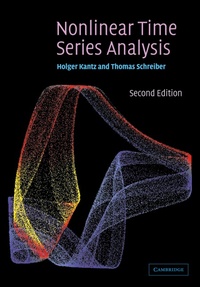
Nonlinear Time Series Analysis
2nd Edition
Published on 27. November 2003
Book
Paperback/Softback
388 pages
978-0-521-52902-0 (ISBN)
Description
The paradigm of deterministic chaos has influenced thinking in many fields of science. Chaotic systems show rich and surprising mathematical structures. In the applied sciences, deterministic chaos provides a striking explanation for irregular behaviour and anomalies in systems which do not seem to be inherently stochastic. The most direct link between chaos theory and the real world is the analysis of time series from real systems in terms of nonlinear dynamics. Experimental technique and data analysis have seen such dramatic progress that, by now, most fundamental properties of nonlinear dynamical systems have been observed in the laboratory. Great efforts are being made to exploit ideas from chaos theory wherever the data displays more structure than can be captured by traditional methods. Problems of this kind are typical in biology and physiology but also in geophysics, economics, and many other sciences.
Reviews / Votes
From reviews of the first edition: '... any serious physics institute should have such a book on its shelves. It will be of use to any experimental scientist dealing with nonlinear data or a theoretical physicist who desires a feeling of 'how one does it in an experiment'. The clear course of presentation should make it accessible to undergraduate students.' Daniel Wojcik, Pageoph 'This book will be of value to any graduate student or researcher who needs to be able to analyse time series data, especially in the fields of physics, chemistry, biology, geophysics, medicine, economics and the social sciences.' Mathematical Reviews '... a very readable introduction to the concepts and clear descriptions of the techniques, as well as cautions, where appropriate, about potential pitfalls and misuses of the methods. ... the book is a good reference to the current state of the art from the nonlinear dynamics community and is important reading for anyone faced with interpreting irregular time series.' Contemporary PhysicsMore details
Edition
2nd Revised edition
Language
English
Place of publication
Cambridge
United Kingdom
Target group
Professional and scholarly
Edition type
Revised edition
Product notice
Paperback (trade)
Illustrations
Worked examples or Exercises; 4 Tables, unspecified; 118 Line drawings, unspecified
Dimensions
Height: 244 mm
Width: 170 mm
Thickness: 21 mm
Weight
668 gr
ISBN-13
978-0-521-52902-0 (9780521529020)
Copyright in bibliographic data and cover images is held by Nielsen Book Services Limited or by the publishers or by their respective licensors: all rights reserved.
Schweitzer Classification
Other editions
Additional editions
Holger Kantz | Thomas Schreiber
Nonlinear Time Series Analysis
E-Book
02/2005
2nd Edition
Cambridge University Press
€73.99
Available for download
Holger Kantz | Thomas Schreiber
Nonlinear Time Series Analysis
Book
11/2003
2nd Edition
Cambridge University Press
€111.42
Article exhausted; check for reprint
Holger Kantz
Nonlinear Time Series Analysis
E-Book
11/2003
Cambridge University Press
€62.49
Available for download
Previous edition
Holger Kantz | Thomas Schreiber
Nonlinear Time Series Analysis
Book
11/2003
2nd Edition
Cambridge University Press
€111.42
Article exhausted; check for reprint
Persons
Content
Preface; Acknowledgements; Part I. Basic Topics: 1. Introduction: why nonlinear methods?; 2. Linear tools and general considerations; 3. Phase space methods; 4. Determinism and predictability; 5. Instability: Lyapunov exponents; 6. Self-similarity: dimensions; 7. Using nonlinear methods when determinism is weak; 8. Selected nonlinear phenomena; Part II. Advanced Topics: 9. Advanced embedding methods; 10. Chaotic data and noise; 11. More about invariant quantities; 12. Modelling and forecasting; 13. Non-stationary signals; 14. Coupling and synchronisation of nonlinear systems; 15. Chaos control; Appendix A: using the TISEAN programs; Appendix B: description of the experimental data sets; References; Index.