

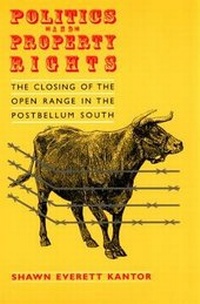
Politics and Property Rights
The Closing of the Open Range in the Postbellum South
Published on 25. April 1998
Book
Paperback/Softback
198 pages
978-0-226-42377-7 (ISBN)
Description
After the American Civil War, agricultural reformers in the South called for an end to unrestricted grazing of livestock on unfenced land. They advocated the stock law, which required livestock owners to fence in their animals, arguing that the existing system (in which farmers built protective fences around crops) was outdated and inhibited economic growth. The reformers steadily won their battles, and by the end of the century the range was on the way to being closed. In this study Shawn Kantor uses economic analysis to assert that contrary to traditional historical interpretation, this conflict was centered on anticipated benefits from fencing livestock rather than on class, cultural or ideological differences. The text seeks to show that the stock law brought economic benefits; and at the same time analyzes why the law's adoption was hindered in many areas where it would have increased wealth. Kantor's argument illuminates the dynamics of real-world institutional change, where transactions are often costly and where some inefficient institutions persist while others give way to economic growth.
More details
Series
Language
English
Place of publication
Chicago
United States
Publishing group
The University of Chicago Press
Target group
College/higher education
Professional and scholarly
Dimensions
Height: 23 mm
Width: 16 mm
Thickness: 1 mm
Weight
312 gr
ISBN-13
978-0-226-42377-7 (9780226423777)
Copyright in bibliographic data and cover images is held by Nielsen Book Services Limited or by the publishers or by their respective licensors: all rights reserved.
Schweitzer Classification