

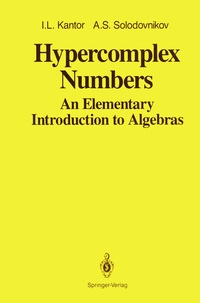
Hypercomplex Numbers
An Elementary Introduction to Algebras
Published on 21. September 2011
Book
Paperback/Softback
X, 169 pages
978-1-4612-8191-7 (ISBN)
Description
This book deals with various systems of "numbers" that can be constructed by adding "imaginary units" to the real numbers. The complex numbers are a classical example of such a system. One of the most important properties of the complex numbers is given by the identity (1) Izz'l = Izl·Iz'I· It says, roughly, that the absolute value of a product is equal to the product of the absolute values of the factors. If we put z = al + a2i, z' = b+ bi, 1 2 then we can rewrite (1) as The last identity states that "the product of a sum of two squares by a sum of two squares is a sum of two squares. " It is natural to ask if there are similar identities with more than two squares, and how all of them can be described. Already Euler had given an example of an identity with four squares. Later an identity with eight squares was found. But a complete solution of the problem was obtained only at the end of the 19th century. It is substantially true that every identity with n squares is linked to formula(1), except that z and z' no longer denote complex numbers but more general "numbers" where i,j, . . . , I are imaginary units. One of the main themes of this book is the establishing of the connection between identities with n squares and formula (1).
More details
Edition
Softcover reprint of the original 1st ed. 1989
Language
English
Place of publication
New York
United States
Target group
Professional and scholarly
Research
Illustrations
X, 169 p.
Dimensions
Height: 235 mm
Width: 155 mm
Thickness: 11 mm
Weight
289 gr
ISBN-13
978-1-4612-8191-7 (9781461281917)
DOI
10.1007/978-1-4612-3650-4
Schweitzer Classification
Other editions
Additional editions
Book
05/1989
Springer
€85.55
Article exhausted; check different version
Persons
Content
I Hypercomplex Numbers.- 1 Complex Numbers.- 2 Alternate Arithmetics on the Numbers a + bi.- 3 Quaternions.- 4 Quaternions and Vector Algebra.- 5 Hypercomplex Numbers.- 6 The Doubling Procedure. Cayley Numbers.- 7 Algebras.- II N-Dimensional Vectors.- 8 The N-Dimensional Vector Space An.- 9 A Basis of The Space An.- 10 Subspaces.- 11 Lemma on Homogeneous Systems of Equations.- 12 Scalar Products.- 13 Orthonormal Basis. Orthogonal Transformation.- III The Exceptional Position of Four Algebras.- 14 Isomorphic Algebras.- 15 Subalgebras.- 16 Translation of the "Problem of the Sum of Squares" into the Language of Algebras. Normed Algebras.- 17 Normed Algebras with an Identity. Hurwitz's Theorem.- 18 A Method for Constructing All Normed Algebras and Its Implications for the Problem of the Sum of Squares.- 19 Frobenius' Theorem.- 20 Commutative Division Algebras.- 21 Conclusion.- 22 Notes.