

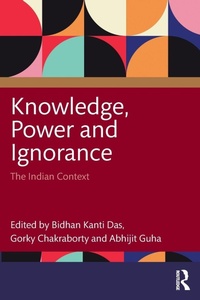
Knowledge, Power and Ignorance
The Indian Context
1st Edition
Published on 21. June 2024
Book
Paperback/Softback
266 pages
978-1-032-78708-4 (ISBN)
Description
What is knowledge, and ignorance? How is it decided? Do power and power relations influence this process? Does the spread of knowledge lead to more ignorance? Is ignorance socially produced? Is knowledge always socially contextualized? This book deals with these important questions on the interplay of knowledge, ignorance and power located in varied contexts in India.
As systematic knowledge grows, so does the possibility of ignorance. Ignorance is a state which people attribute to others and is loaded with moral judgment. Thus, being underdeveloped often 'implies a kind of stupidity or failure'. This volume seeks to be premised in a framework where ignorance is understood as being a socially produced and maintained phenomenon, where the ways of knowing and not knowing are interdependent. It is a novel attempt for an academic re-orientation of the Knowledge-Ignorance paradigm through a process of re-interpretation of the bounded purview attached with the existing epistemological understandings. It focuses on concrete case studies, often with an ethnographic stint. The volume critically looks at various aspects: Epistemological Issues; Understanding Community Perspectives and the State; Natural Resources, Power and Ignorance; Media and Production of Non-Knowledge; and other emerging areas. Each essay bears a striking similarity - that of understanding the complex processes and dynamics of the production of ignorance in a field of commonly held beliefs of 'knowledge' - be it scientific, societal, religious, magical or political - through the overarching realm of power.
This interdisciplinary volume will be of interest to a cross-section of academics and students of sociology, social anthropology, political science, human geography, history, public policy and development studies.
As systematic knowledge grows, so does the possibility of ignorance. Ignorance is a state which people attribute to others and is loaded with moral judgment. Thus, being underdeveloped often 'implies a kind of stupidity or failure'. This volume seeks to be premised in a framework where ignorance is understood as being a socially produced and maintained phenomenon, where the ways of knowing and not knowing are interdependent. It is a novel attempt for an academic re-orientation of the Knowledge-Ignorance paradigm through a process of re-interpretation of the bounded purview attached with the existing epistemological understandings. It focuses on concrete case studies, often with an ethnographic stint. The volume critically looks at various aspects: Epistemological Issues; Understanding Community Perspectives and the State; Natural Resources, Power and Ignorance; Media and Production of Non-Knowledge; and other emerging areas. Each essay bears a striking similarity - that of understanding the complex processes and dynamics of the production of ignorance in a field of commonly held beliefs of 'knowledge' - be it scientific, societal, religious, magical or political - through the overarching realm of power.
This interdisciplinary volume will be of interest to a cross-section of academics and students of sociology, social anthropology, political science, human geography, history, public policy and development studies.
More details
Language
English
Place of publication
London
United Kingdom
Publishing group
Taylor & Francis Ltd
Target group
College/higher education
Postgraduate
Illustrations
7 s/w Abbildungen, 7 s/w Zeichnungen, 5 s/w Tabellen
5 Tables, black and white; 7 Line drawings, black and white; 7 Illustrations, black and white
Dimensions
Height: 234 mm
Width: 156 mm
Thickness: 15 mm
Weight
436 gr
ISBN-13
978-1-032-78708-4 (9781032787084)
Copyright in bibliographic data and cover images is held by Nielsen Book Services Limited or by the publishers or by their respective licensors: all rights reserved.
Schweitzer Classification
Other editions
Additional editions
Bidhan Kanti Das | Gorky Chakraborty | Abhijit Guha
Knowledge, Power and Ignorance
The Indian Context
Book
06/2024
1st Edition
Routledge India
€206.70
Shipment within 10-20 days
Bidhan Kanti Das | Gorky Chakraborty | Abhijit Guha
Knowledge, Power and Ignorance
The Indian Context
E-Book
06/2024
1st Edition
CRC Press
€53.99
Available for download
Bidhan Kanti Das | Gorky Chakraborty | Abhijit Guha
Knowledge, Power and Ignorance
The Indian Context
E-Book
06/2024
1st Edition
CRC Press
€53.99
Available for download
Persons
Bidhan Kanti Das is Associate Professor of Anthropology at the Institute of Development Studies Kolkata (IDSK). He has been teaching development studies for last 15 years and is also engaged in research in local forest management, and problems of marginalized communities. He has published research articles in national and international journal of repute.
Gorky Chakraborty is faculty at Institute of Development Studies Kolkata (IDSK), working on issues related to the development of North East India.
Abhijit Guha is a former Professor of Anthropology at Vidyasagar University. He acted as an expert of the Standing Committee on Rural Development of the Lok Sabha in 2008,advising on the Land Acquisition and Resettlement and Rehabilitation Amendment Bills. He is also the author of Encountering Land Grab: An Ethnographic Journey (2022).
Gorky Chakraborty is faculty at Institute of Development Studies Kolkata (IDSK), working on issues related to the development of North East India.
Abhijit Guha is a former Professor of Anthropology at Vidyasagar University. He acted as an expert of the Standing Committee on Rural Development of the Lok Sabha in 2008,advising on the Land Acquisition and Resettlement and Rehabilitation Amendment Bills. He is also the author of Encountering Land Grab: An Ethnographic Journey (2022).
Content
Part I: Introduction Introduction: Exploring Knowledge, Power and Ignorance- Bidhan Kanti Das, Gorky Chakraborty and Abhijit Guha Part II: Epistemological Issues 1. Reimagining Ignorance and Forced Migration: Connections and Possibilities- Sudeep Basu 2. Knowledge, Power and Ignorance: Views from a Gendered Lens- Nagmani Rao Part III: Understanding Community Perspectives and the State 3. The Interplay of Knowledge, Power and Ignorance: Looking through the Lens of Community-Rajat Kanti Das 4. State Making, Ignorance and Power: Experiences from a De-notified Community in Central India- Ratna Dhar 5. The Sentinel Islanders and the Myth of Cannibalism: "Popular Ignorance" as Knowledge-Mundayat Sasikumar Part IV: Natural Resources, Power and Ignorance 6. What I believed to be true was part of the larger whole: the story of land grab in Medinipur-Abhijit Guha 7. Strategic Ignorance for Bureaucratic control? Examining forest governance practices in India-Bidhan Kanti Das 8. Knowledge and the Heft of Ignorance: The Government of Conservation Infrastructure in Sundarbans, West Bengal- Raktim Mazumder and Gorky Chakraborty 9. Knowledge and Policy/Practice in the Water Sector: Illustrating Contestations and Disconnectedness- K. J. Joy, Bejoy K. Thomas and Jyoti Nair Part V: Media and Production of Non-Knowledge 10. Trajectories of Post-Truth: Floating Signifiers and the Aspects of Ignorance in Public Sphere - Suman Nath 11. Media, Information and Quality of Knowledge: A Study of Health News from Two Newspapers- Subrata Mukherjee and Tiasha Dhar Part VI: Emerging Areas 12. Comics - A Children's Genre? Censorship, Fantasy and Critique- Roma Chatterji 13. Ignoring Low-fee Private Schools in India- Soumyabrato Bagchi, Bhaskar Chakrabarti and Rituparna Das