

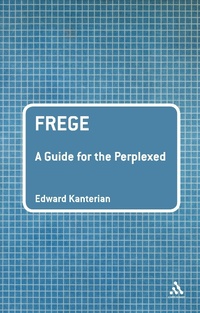
Frege: A Guide for the Perplexed
Published on 2. August 2012
Book
Paperback/Softback
264 pages
978-0-8264-8764-3 (ISBN)
Description
This is a guide to the thought and ideas of Gottlob Frege, one of the most important but also perplexing figures in the history of analytic philosophy. Gottlob Frege is regarded as one of the founders of modern logic and analytic philosophy, indeed as the greatest innovator in logic since Aristotle. His groundbreaking work identified many of the basic conceptions and distinctions that later came to dominate analytic philosophy. The literature on him is legion and ever-growing in complexity, representing a considerable challenge to the non-expert. The details of his logic, which have come into focus in recent research, are particularly difficult to grasp, although they are crucial to the development of his grand project, the reduction of arithmetic to logic, and the associated philosophical innovations. This book offers a lucid and accessible introduction to Frege's logic, taking the reader directly to the core of his philosophy, and ultimately to some of the most pertinent issues in contemporary philosophy of language, logic, mathematics, and the mind.
"Continuum's Guides for the Perplexed" are clear, concise and accessible introductions to thinkers, writers and subjects that students and readers can find especially challenging - or indeed downright bewildering. Concentrating specifically on what it is that makes the subject difficult to grasp, these books explain and explore key themes and ideas, guiding the reader towards a thorough understanding of demanding material.
"Continuum's Guides for the Perplexed" are clear, concise and accessible introductions to thinkers, writers and subjects that students and readers can find especially challenging - or indeed downright bewildering. Concentrating specifically on what it is that makes the subject difficult to grasp, these books explain and explore key themes and ideas, guiding the reader towards a thorough understanding of demanding material.
Reviews / Votes
'This is a splendid book. In a lucid and leisurely style it explains the ideas of the greatest logician since Leibniz and a seminal figure in the growth both of analytical philosophy and of its continental rivals. The author shirks no difficulties. He provides the first book-length elucidation of Frege's original logical notation. He thoroughly explores such ideas as the function-argument and the sense-reference distinction, judiciously discriminating between what we should retain and what we should discard. He sheds a bright light into the darkest recesses of Frege's intricate thought.' -- Michael Inwood, Professor Emeritus, Trinity College, University of Oxford, UKMore details
Series
Language
English
Place of publication
New York
United States
Target group
College/higher education
Dimensions
Height: 224 mm
Width: 141 mm
Thickness: 18 mm
Weight
326 gr
ISBN-13
978-0-8264-8764-3 (9780826487643)
Copyright in bibliographic data and cover images is held by Nielsen Book Services Limited or by the publishers or by their respective licensors: all rights reserved.
Schweitzer Classification
Other editions
Additional editions

E-Book
05/2012
1st Edition
Continuum Publishing Corporation
€28.49
Available for download

E-Book
05/2012
1st Edition
Bloomsbury Continuum
€28.49
Available for download
Person
Edward Kanterian is lecturer in philosophy at the University of Oxford, and the author of Analytic Philosophy (2004) and Wittgenstein (2007).
Content
Introduction; 1. The Historical Setting: Logic and Mathematics in the 19th Century; 2. A Revolution in Logic: Begriffsschrift; a. The aim of the calculus; b. The analysis of judgement; c. The formal system; d. Some applications; e. Open issues; 3. Frege's Prolegomena: The Foundations of Arithmetic; a. Aim and limitations of the argument; b. Refuting empiricism and psychologism; c. Platonism; d. The definition of numbers as logical objects; 4. Arithmetic as a System: The Basic Laws of Arithmetic; a. The structure and role of a system; b. Modifications of the calculus; c. The formal system; d. Applications to number theory; e. Russell's paradox; 5. Later Developments; a. Thoughts and their composition: Logical Investigations; b. The return to the geometrical foundations of arithmetic; 6. Frege's Importance; a. The early impact: Russell, Wittgenstein, Carnap; b. Semantics; c. Neo-logicism; d. Unexplored issues; 7. Conclusion: Reading Frege; Appendix I. Suggested Exercises; Appendix II. List of Formal Symbols; Bibliography; Index.