

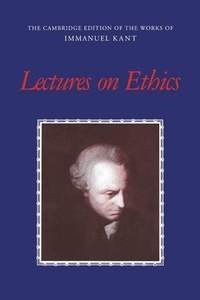
Lectures on Ethics
Published on 28. March 1997
Book
Hardback
540 pages
978-0-521-56061-0 (ISBN)
Description
This volume contains four versions of the lecture notes taken by Kant's students of his university courses in ethics given regularly over a period of some thirty years. The notes are very complete and expound not only Kant's views on ethics but many of his opinions on life and human nature. Much of this material has never before been translated into English. As with other volumes in the series, there are copious linguistic and explanatory notes and a glossary of key terms.
Reviews / Votes
"A very useful supplement of Kant's published writings in ethics." G. Zoeller, Choice "...an important service to English-speaking scholars interested in Kant's moral philosophy. ...a most welcome volume." Review of MetaphysicsMore details
Series
Language
English
Place of publication
Cambridge
United Kingdom
Target group
College/higher education
Professional and scholarly
Dimensions
Height: 240 mm
Width: 161 mm
Thickness: 33 mm
Weight
969 gr
ISBN-13
978-0-521-56061-0 (9780521560610)
Copyright in bibliographic data and cover images is held by Nielsen Book Services Limited or by the publishers or by their respective licensors: all rights reserved.
Schweitzer Classification
Persons
Immanuel Kant ( 22 April 1724 - 12 February 1804) was an influential German philosopher[23] in the Age of Enlightenment. In his doctrine of transcendental idealism, he argued that space, time, and causation are mere sensibilities; "things-in-themselves" exist, but their nature is unknowable.[24][25] In his view, the mind shapes and structures experience, with all human experience sharing certain structural features. In one of his major works, the Critique of Pure Reason (1781; second edition 1787),[26] he drew a parallel to the Copernican revolution in his proposition that worldly objects can be intuited a priori ('beforehand'), and that intuition is therefore independent from objective reality.[b]
Kant believed that reason is also the source of morality, and that aesthetics arise from a faculty of disinterested judgment. Kant's views continue to have a major influence on contemporary philosophy, especially the fields of epistemology, ethics, political theory, and post-modern aesthetics. He attempted to explain the relationship between reason and human experience and to move beyond the failures of traditional philosophy and metaphysics. He wanted to put an end to what he saw as an era of futile and speculative theories of human experience, while resisting the skepticism of thinkers such as David Hume. He regarded himself as showing the way past the impasse between rationalists and empiricists,[28] and is widely held to have synthesized both traditions in his thought.[29]
Kant was an exponent of the idea that perpetual peace could be secured through universal democracy and international cooperation. He believed that this would be the eventual outcome of universal history, although it is not rationally planned.[30] The nature of Kant's religious ideas continues to be the subject of philosophical dispute, with viewpoints ranging from the impression that he was an initial advocate of atheism who at some point developed an ontological argument for God, to more critical treatments epitomized by Schopenhauer, who criticized the imperative form of Kantian ethics as "theological morals" and the "Mosaic Decalogue in disguise",[31] and Nietzsche, who claimed that Kant had "theologian blood"[32] and was merely a sophisticated apologist for traditional Christian faith
Kant believed that reason is also the source of morality, and that aesthetics arise from a faculty of disinterested judgment. Kant's views continue to have a major influence on contemporary philosophy, especially the fields of epistemology, ethics, political theory, and post-modern aesthetics. He attempted to explain the relationship between reason and human experience and to move beyond the failures of traditional philosophy and metaphysics. He wanted to put an end to what he saw as an era of futile and speculative theories of human experience, while resisting the skepticism of thinkers such as David Hume. He regarded himself as showing the way past the impasse between rationalists and empiricists,[28] and is widely held to have synthesized both traditions in his thought.[29]
Kant was an exponent of the idea that perpetual peace could be secured through universal democracy and international cooperation. He believed that this would be the eventual outcome of universal history, although it is not rationally planned.[30] The nature of Kant's religious ideas continues to be the subject of philosophical dispute, with viewpoints ranging from the impression that he was an initial advocate of atheism who at some point developed an ontological argument for God, to more critical treatments epitomized by Schopenhauer, who criticized the imperative form of Kantian ethics as "theological morals" and the "Mosaic Decalogue in disguise",[31] and Nietzsche, who claimed that Kant had "theologian blood"[32] and was merely a sophisticated apologist for traditional Christian faith
Content
Introduction J. B. Schneedwind; Part I. Kant's Practical Philosophy: 1. Herder's lecture notes (selections); Part II. Moral Philosophy: 2. Collins's lecture notes; Part III. Morality According to Professor Kant: 3. Mrongovius's second set of lecture notes (selections); Part IV. Kant on the Metaphyscics of Morals: 4. Vigilantius's lecture notes.