

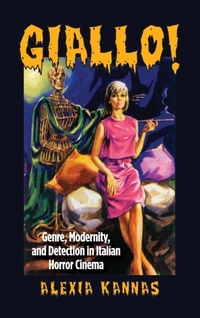
Giallo!
Genre, Modernity, and Detection in Italian Horror Cinema
Published on 1. November 2020
Book
Hardback
184 pages
978-1-4384-8033-6 (ISBN)
Description
Traces the giallo mystery/horror genre from its genesis in Italian cinema of the 1960s and 1970s to its contemporary place in the global cult-film canon.
Italian giallo films have a peculiar allure. Taking their name from the Italian for "yellow"- reflecting the covers of pulp crime novels-these genre movies were principally produced between 1960 and the late 1970s. These cinematic hybrids of crime, horror, and detection are characterized by elaborate set-piece murders, lurid aesthetics, and experimental soundtracks. Using critical frameworks drawn from genre theory, reception studies, and cultural studies, Giallo! traces this historically marginalized genre's journey from Italian cinemas to the global cult-film canon. Through close textual analysis of films including The Girl Who Knew Too Much (1963), Blood and Black Lace (1964), The Bird with the Crystal Plumage (1970), The Black Belly of the Tarantula (1971), and The Case of the Bloody Iris (1972), Alexia Kannas considers the rendering of urban space in the giallo and how it expresses a complex and unsettling critique of late modernity.
Italian giallo films have a peculiar allure. Taking their name from the Italian for "yellow"- reflecting the covers of pulp crime novels-these genre movies were principally produced between 1960 and the late 1970s. These cinematic hybrids of crime, horror, and detection are characterized by elaborate set-piece murders, lurid aesthetics, and experimental soundtracks. Using critical frameworks drawn from genre theory, reception studies, and cultural studies, Giallo! traces this historically marginalized genre's journey from Italian cinemas to the global cult-film canon. Through close textual analysis of films including The Girl Who Knew Too Much (1963), Blood and Black Lace (1964), The Bird with the Crystal Plumage (1970), The Black Belly of the Tarantula (1971), and The Case of the Bloody Iris (1972), Alexia Kannas considers the rendering of urban space in the giallo and how it expresses a complex and unsettling critique of late modernity.
Reviews / Votes
"...[Kannas] offers fresh insights into the giallo film-especially concerning its use of excess and decadence to register the last gasp of modernity and modernism-that make the volume valuable to those interested in cult movies and popular Italian cinema." - CHOICE"This is a distinctive text that crosses the boundaries of national cinema, popular forms, theoretical works of modernity and modernism, and spectatorship. Kannas does an excellent job of blending different aspects of film and cultural theory, reception, and textuality. It's a pleasure to read." - Marcia Landy, author of Stardom, Italian Style: Screen Performance and Personality in Italian Cinema
More details
Series
Language
English
Place of publication
Albany, NY
United States
Target group
Professional and scholarly
US School Grade: College Graduate Student and over
Illustrations
15 Illustrations, black and white
Dimensions
Height: 235 mm
Width: 157 mm
Thickness: 15 mm
Weight
426 gr
ISBN-13
978-1-4384-8033-6 (9781438480336)
Copyright in bibliographic data and cover images is held by Nielsen Book Services Limited or by the publishers or by their respective licensors: all rights reserved.
Schweitzer Classification
Other editions
Additional editions
E-Book
11/2020
1st Edition
De Gruyter
from
€81.99
Available for download
Person
Alexia Kannas is Lecturer in Media and Cinema Studies in the School of Media and Communication, RMIT University in Melbourne, Australia. She is the author of Deep Red.
Content
List of Illustrations
Acknowledgments
Introduction
1. The Problem of Genre
2. The Cultification of the Italian Giallo
3. No Place like Home: The Late-Modern City
4. Those Who Wait: Tourists, Detectives, and Urban Experience in the Giallo City
5. The Most Unnatural Kind of Death
Conclusion
Works Cited
Filmography
Index
Acknowledgments
Introduction
1. The Problem of Genre
2. The Cultification of the Italian Giallo
3. No Place like Home: The Late-Modern City
4. Those Who Wait: Tourists, Detectives, and Urban Experience in the Giallo City
5. The Most Unnatural Kind of Death
Conclusion
Works Cited
Filmography
Index