

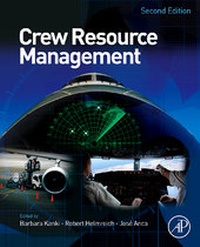
Crew Resource Management
2nd Edition
Published on 26. March 2010
Book
Paperback/Softback
536 pages
978-0-12-374946-8 (ISBN)
Description
Crew Resource Management, Second Edition continues to focus on CRM in the cockpit, but also emphasizes that the concepts and training applications provide generic guidance and lessons learned for a wide variety of "crews" in the aviation system as well as in the complex and high-risk operations of many non-aviation settings. Long considered the "bible" in this field, much of the basic style and structure of the previous edition of Crew Resource Management is retained in the new edition. Textbooks are often heavily supplemented with or replaced entirely by course packs in advanced courses in the aviation field, as it is essential to provide students with cutting edge information from academic researchers, government agencies (FAA), pilot associations, and technology (Boeing, ALION). This edited textbook offers ideal coverage with first-hand information from each of these perspectives. Case examples, which are particularly important given the dangers inherent in real world aviation scenarios, are liberally supplied. An image collection and test bank make this the only text on the market with ancillary support.
More details
Edition
2nd edition
Language
English
Place of publication
San Diego
United States
Publishing group
Elsevier Science Publishing Co Inc
Target group
Professional and scholarly
Primary:
Graduate students in aviation training, aviation psychology and human factors courses; aviation professionals in government, private, commercial and military settings (flight training, CRM facilitators, selection and recruitment specialists, instructor pilots, accident investigators, safety pilots, ATC personnel, aircraft engineers); aviation researchers.
Secondary:
Reference librarians at schools with human factors or aviation/aeronautical programs; trainers, managers and safety/quality personnel in other high-risk industries (emergency medicine, fire-fighters).
Dimensions
Height: 235 mm
Width: 191 mm
Weight
1010 gr
ISBN-13
978-0-12-374946-8 (9780123749468)
Copyright in bibliographic data and cover images is held by Nielsen Book Services Limited or by the publishers or by their respective licensors: all rights reserved.
Schweitzer Classification
Other editions
New editions
Barbara G. Kanki | Jose Anca | Thomas R. Chidester
Crew Resource Management
Book
02/2019
3rd Edition
Academic Press
€139.50
Shipment within 15-20 days
Additional editions
Barbara G. Kanki | Robert L. Helmreich | Jose Anca
Crew Resource Management
E-Book
05/2014
2nd Edition
Academic Press
€80.95
Available for download
Previous edition

Earl L. Wiener | Barbara G. Kanki | Robert L. Helmreich
Crew Resource Management
Book
11/1995
Academic Press
€54.46
Article exhausted; check for reprint
Persons
Dr. Barbara Kanki served as a Research Scientist at the National Aeronautics and Space Administration (NASA), Ames Research Center (Moffett Field, California) in the Human Systems Integration Division. Over her tenure of more than 25 years, she conducted human performance research in support of NASA Aviation Safety Programs, Human Factors and Performance for Space Safety, and a variety of Human Factors programs for the Federal Aviation Administration (FAA). In a consulting role she worked with other high risk industries such as the medical and nuclear power fields.
Dr. Kanki's research activities have ranged across human factors topics such as crew communication and coordination, organizational factors, information and workload management for aviation operations including flight crews, ground control, and technical operations. Her research interests include human-centered procedure and document design, integration and training for new technologies as well as safety topics such as voluntary reporting and event investigation. She has supported the space side of NASA in human and socio-technical risk factors, team training, and procedure design primarily for the space shuttle program at Kennedy Space Center and has participated on NASA mishap boards, safety assessments and National Transportation Safety Board human performance investigations. After retiring from NASA in 2014, Dr. Kanki continues to contribute to NASA projects and FAA/industry groups, and is the current chair of the Human Performance working group of the International Association for the Advancement of Space Safety.
Dr. Kanki received her doctorate in Behavioral Sciences from the University of Chicago, where she specialized in the areas of communication and group dynamics. She continues to author, edit, and review books, journals, and papers on human factors topics. Joey Anca is the Human Risk Manager for Metro Trains Melbourne in Australia. Joey has a long career in aviation, having pioneered with Bob Helmreich the Cockpit Management Attitudes Questionnaire (CMAQ), when the known universe was grappling with the new-found pill of Crew Resource Management (CRM). Bob (the NASA/UT team, Joey and other aviation earthlings) took off into other safety-critical domains. Joey is a proud Filipino who has worked in a number of airlines and railways in Australasia. He lives in Melbourne, Australia and teaches Threat and Error Management (TEM) at Swinburne University of Technology. His day-job is keeping the railways in Melbourne safe. Robert L. Helmreich is professor of psychology at the University of Texas at Austin. He received his Ph.D. in personality and social psychology from Yale University in 1966. He has conducted research on group processes and performance sponsored by NASA, the Office of Naval Research, and the FAA, as well as research on personality and motivation sponsored by the National Science Foundation and the National Institute of Mental Health. He is a fellow of the American Psychological Association and the American Psychological Society and former editor of the Journal of Personality and Social Psychology. He was chair of an FAA working group to develop the National Plan for Aviation Human Factors. He is a member of the National Academy of Sciences Committee on Space Biology and Medicine and Committee on Human Factors. He is Director of the NASA/University of Texas/FAA Aerospace Crew Performance Project investigating issues in crew selection, training, and performance evaluation in both aviation and space environments.
Dr. Kanki's research activities have ranged across human factors topics such as crew communication and coordination, organizational factors, information and workload management for aviation operations including flight crews, ground control, and technical operations. Her research interests include human-centered procedure and document design, integration and training for new technologies as well as safety topics such as voluntary reporting and event investigation. She has supported the space side of NASA in human and socio-technical risk factors, team training, and procedure design primarily for the space shuttle program at Kennedy Space Center and has participated on NASA mishap boards, safety assessments and National Transportation Safety Board human performance investigations. After retiring from NASA in 2014, Dr. Kanki continues to contribute to NASA projects and FAA/industry groups, and is the current chair of the Human Performance working group of the International Association for the Advancement of Space Safety.
Dr. Kanki received her doctorate in Behavioral Sciences from the University of Chicago, where she specialized in the areas of communication and group dynamics. She continues to author, edit, and review books, journals, and papers on human factors topics. Joey Anca is the Human Risk Manager for Metro Trains Melbourne in Australia. Joey has a long career in aviation, having pioneered with Bob Helmreich the Cockpit Management Attitudes Questionnaire (CMAQ), when the known universe was grappling with the new-found pill of Crew Resource Management (CRM). Bob (the NASA/UT team, Joey and other aviation earthlings) took off into other safety-critical domains. Joey is a proud Filipino who has worked in a number of airlines and railways in Australasia. He lives in Melbourne, Australia and teaches Threat and Error Management (TEM) at Swinburne University of Technology. His day-job is keeping the railways in Melbourne safe. Robert L. Helmreich is professor of psychology at the University of Texas at Austin. He received his Ph.D. in personality and social psychology from Yale University in 1966. He has conducted research on group processes and performance sponsored by NASA, the Office of Naval Research, and the FAA, as well as research on personality and motivation sponsored by the National Science Foundation and the National Institute of Mental Health. He is a fellow of the American Psychological Association and the American Psychological Society and former editor of the Journal of Personality and Social Psychology. He was chair of an FAA working group to develop the National Plan for Aviation Human Factors. He is a member of the National Academy of Sciences Committee on Space Biology and Medicine and Committee on Human Factors. He is Director of the NASA/University of Texas/FAA Aerospace Crew Performance Project investigating issues in crew selection, training, and performance evaluation in both aviation and space environments.
Content
PART 1 THE NATURE OF CRM
1. Why CRM? Empirical and Theoretical Bases of Human Factors Training
2. Teamwork and Organizational Factors
3. Crews as Groups: Their Formation and their Leadership
4. Communication and Crew Resource Management
5. Flight Crew Decision-Making
6. CRM (Non-Technical) Skills d Applications for and Beyond the Flight Deck
PART 2 CRM TRAINING APPLICATIONS
7. The Design, Delivery and Evaluation of Crew Resource Management Training
8. Line Oriented Flight Training (LOFT): The Intersection of Technical and Human Factor Crew Resource Management (CRM) Team Skills
9. Line Operations Simulation Development Tools
10. Crew Resource Management (CRM) and Line Operations Safety Audit (LOSA)
11. Crew Resource Management: Spaceflight Resource Management
12. The Migration of Crew Resource Management Training
PART 3 CRM PERSPECTIVES
13. A Regulatory Perspective
14. A Regulatory Perspective II
15. Integrating CRM into an Airline's Culture: The Air Canada Process
16. The Accident Investigator's Perspective
17. The Airlines' Perspective: Effectively Applying Crew Resource Management Principles in Today's Aviation Environment
18. Conversations on CRM from Outside the USA
19. The Military Perspective
PART 4 CONCLUSIONS
20. Airline Pilot Training Today and Tomorrow
21. The Future of CRM
1. Why CRM? Empirical and Theoretical Bases of Human Factors Training
2. Teamwork and Organizational Factors
3. Crews as Groups: Their Formation and their Leadership
4. Communication and Crew Resource Management
5. Flight Crew Decision-Making
6. CRM (Non-Technical) Skills d Applications for and Beyond the Flight Deck
PART 2 CRM TRAINING APPLICATIONS
7. The Design, Delivery and Evaluation of Crew Resource Management Training
8. Line Oriented Flight Training (LOFT): The Intersection of Technical and Human Factor Crew Resource Management (CRM) Team Skills
9. Line Operations Simulation Development Tools
10. Crew Resource Management (CRM) and Line Operations Safety Audit (LOSA)
11. Crew Resource Management: Spaceflight Resource Management
12. The Migration of Crew Resource Management Training
PART 3 CRM PERSPECTIVES
13. A Regulatory Perspective
14. A Regulatory Perspective II
15. Integrating CRM into an Airline's Culture: The Air Canada Process
16. The Accident Investigator's Perspective
17. The Airlines' Perspective: Effectively Applying Crew Resource Management Principles in Today's Aviation Environment
18. Conversations on CRM from Outside the USA
19. The Military Perspective
PART 4 CONCLUSIONS
20. Airline Pilot Training Today and Tomorrow
21. The Future of CRM