

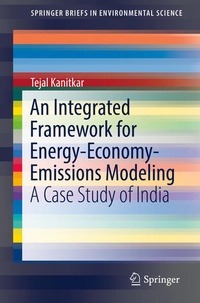
An Integrated Framework for Energy-Economy-Emissions Modeling
A Case Study of India
Published on 13. June 2019
Book
Paperback/Softback
XVIII, 117 pages
978-3-030-18262-5 (ISBN)
Description
This book combines three different energy-economy-emissions modeling methodologies into one Integrated Modeling Framework (IMF) in an attempt to fill gaps in current modeling research as it applies to developing countries. Through the analysis of existing mathematical models, including large macro-economic models and technology-explicit energy models, the work proposes planning methodologies for developing countries that face challenges on their economy and infrastructure due to climate change. The three modeling methodologies discussed in the chapters are a decomposition analysis of trends in emissions intensity of GDP, linear programming techniques to determine optimum energy supply pathways given various resource and emissions constraints, and an input-output analysis to evaluate the impact of energy policies on income and equity.
After a brief introduction to the history of the development of energy studies and the linkages between energy, economic, and environmental systems, the book delves into the component methodologies of the IMF and their intended outcomes. The decomposition analysis is intended to gauge the energy intensity of GDP and the structural composition of the economy to provide a basis on which scenarios are constructed in the following two methodologies. The linear programs are meant to develop a methodology to determine energy options under a variety of scenarios that capture the technical and economic characteristics of the power sector of developing countries. Lastly, the input-output analysis aims to build a methodology through which energy policy decisions can be understood and quantified to ensure the best possible impacts on developing economies and societies. Those who will be interested in this book include policy makers, academics, and students and professionals working on energy studies and energy-economy modeling.
After a brief introduction to the history of the development of energy studies and the linkages between energy, economic, and environmental systems, the book delves into the component methodologies of the IMF and their intended outcomes. The decomposition analysis is intended to gauge the energy intensity of GDP and the structural composition of the economy to provide a basis on which scenarios are constructed in the following two methodologies. The linear programs are meant to develop a methodology to determine energy options under a variety of scenarios that capture the technical and economic characteristics of the power sector of developing countries. Lastly, the input-output analysis aims to build a methodology through which energy policy decisions can be understood and quantified to ensure the best possible impacts on developing economies and societies. Those who will be interested in this book include policy makers, academics, and students and professionals working on energy studies and energy-economy modeling.
More details
Series
Edition
2020 ed.
Language
English
Place of publication
Cham
Switzerland
Publishing group
Springer International Publishing
Target group
Professional and scholarly
Illustrations
4 s/w Abbildungen, 13 farbige Abbildungen
XVIII, 117 p. 17 illus., 13 illus. in color.
Dimensions
Height: 235 mm
Width: 155 mm
Thickness: 8 mm
Weight
247 gr
ISBN-13
978-3-030-18262-5 (9783030182625)
DOI
10.1007/978-3-030-18263-2
Schweitzer Classification
Other editions
Additional editions
E-Book
05/2019
1st Edition
Springer
€58.84
Available for download
Person
Dr. Tejal Kanitkar is an Assistant Professor and Chairperson in the Center for Climate Change and Sustainability Studies at the Tata Institute of Social Sciences in Mumbai, India. She received her Masters in engineering at the University of Massachusetts, Amherst in 2006, and her PhD at the Indian Institute of Technology, Mumbai in 2016. She teaches Energy and Climate Change Mitigation, and engages in inter-disciplinary research focused on where the natural and social sciences intersect with nature and the impacts of anthropogenic global warming. Dr. Kanitkar is a certified Energy Auditor with the Bureau of Energy Efficiency for the Government of India, and has been trained in the U.S. Department of Energy's Assessment Software for Steam Systems, Pump Systems, and Process Heating.
Content
Chapter1. Introduction.- Chapter 2. Literature Review.- Chapter 3. Evaluation of Emissions Indicators Using Decomposition Analysis.- Chapter 4. Optimal Pathways for Power Supply.- Chapter 5. Analysis of Energy-Economy Linkages Using a Social Accounting Matrix.- Chapter 6. An Integrated Modeling Framework (IMF) for Energy-Economy-Environment Modeling.- Chapter 7. Conclusion.