

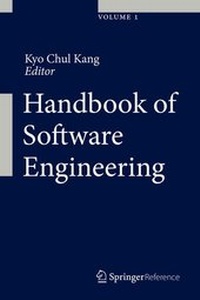
Handbook of Software Engineering 2019
Published on 10. October 2020
Book
Mixed media product
2200 pages
978-94-007-6041-7 (ISBN)
Description
There are many books on specific topics or books on software engineering in general. Most of these books cover only recent technologies or technologies in use but there are few books in existence that give a broad coverage of researches and provide a perspective on how these researches are inter-related and have evolved, which is the understanding needed by all researchers and software engineers. Often beginners must do a labor intensive literature survey to start a research, or they often reinvent the wheel. Handbook of Software Engineering has an ambitious but very necessary brief. It seeks to provide a complete overview of the field of software engineering with additional focus on the historical perspective and description of technology evolution that provides a crucial context for researchers as well as engineers to develop new solutions in a rapidly advancing area. The book aims to give a broad coverage of definition of terms, concepts, engineering principles, methods, and processes, and an understanding of how these have evolved but welded into a discursive narrative in the form of topical chapters.
This book will be divided into sections listed below and items in each section will be organized in a time line to give a historical perspective on technology development and evolution.
This book will be divided into sections listed below and items in each section will be organized in a time line to give a historical perspective on technology development and evolution.
More details
Edition
2020 ed.
Language
English
Place of publication
Dordrecht
Netherlands
Target group
Professional and scholarly
Research
Illustrations
biography
Dimensions
Height: 235 mm
Width: 155 mm
ISBN-13
978-94-007-6041-7 (9789400760417)
Copyright in bibliographic data and cover images is held by Nielsen Book Services Limited or by the publishers or by their respective licensors: all rights reserved.
Schweitzer Classification
Other editions
Additional editions
Kyo-Chul Kang | Sungdeok Cha
Handbook of Software Engineering
Book
07/2019
Springer
€1,284.00
Shipment within 15-20 days
Persons
Prof. Kyo-Chul Kang started a research career in software engineering at the University of Michigan in 1976 where he studied requirements engineering. He was a member of the team developing PSL/PSA, the first ever requirements modeling and analysis technology and also the first CASE (computer-aided software engineering) environment. Prof. Kang had a chance to learn many industrial software engineering methods. The PSL/PSA technology evolved into the Meta Modeling concept, which is now widely practiced in the software engineering community. He moved to Bell Communications Research and then to Bell Labs, where he conducted research on software reuse. At Software Engineering Institute (SEI), Carnegie Mellon University he continued his research on software reuse. Along with team members Prof. Kang developed a method called FODA (Feature-Oriented Domain Analysis) at the SEI, which is now a de facto standard technique for domain analysis in the context of software reuse and product line engineering. The citation count based on Google Scholar now goes over 2500. He served as steering committee members of several international conferences and workshops and also served as a general chair and program committee member of many international conferences and workshops. He reviews over 50 papers per year for conferences and journals, and thus has a wide contact with international researchers. Prof. Sungdeok (Steve) Cha is a professor of computer science and engineering at Korea University in Seoul, Korea. He was also a professor in the Computer Science Department of KAIST, Daejon, Korea, from 1994 through 2008. He received a Ph.D. degree from the Information and Computer Science Department, University of California, Irvine in 1991. He is a member of the editorial board of the Software Testing, Verification and Reliability Journal. He served as the director of the Defense Software Research Center at KAIST as well as the Center for Engineering and Education of Dependable Software at Korea University. His research topic is in software engineering, and in particular software safety, requirements engineering and computer security.
Content
Chapter 1: introduction to the subject area The introduction will include an explanation of what this subject area is about in the context of software engineering. Major software engineering issues and activities relevant to the subject area will be explained. Topics within the subject will also be introduced. Chapter 2: concepts and principles Any engineering concepts relevant to the subject area will be defined. Examples will be provided to help understanding the concepts and principles. The purpose of this chapter is to help beginners understand the basic concepts quickly. Students and researchers who start researches on the subject can be equipped with the knowledge they need to understand the more advanced topics. Chapter 3: Seminal works and references This chapter will be divided into sections based on the topics (introduced in Chapter 1) in the subject area. Seminal works on each topic and related researches will be introduced on a time-line (creating a genealogy) so that readers can understand how technologies have evolved and how they are related to each other. Authors of seminal works will be invited to contribute a summary or an update of their works. Contributions will be included in this chapter. The purpose of this chapter is to help readers understand the historical background of technologies in the subject area. Researchers and students often perform a literature survey to understand a topical area, which is a time-consuming task. Readers can quickly jump into the referenced materials if we provide links to the original papers.