

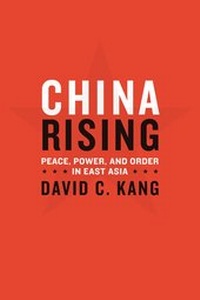
China Rising
Peace, Power, and Order in East Asia
Published on 23. December 2009
Book
Paperback/Softback
296 pages
978-0-231-14189-5 (ISBN)
Description
Throughout the past three decades East Asia has seen more peace and stability than at any time since the Opium Wars of 1839-1841. During this period China has rapidly emerged as a major regional power, averaging over nine percent economic growth per year since the introduction of its market reforms in 1978. Foreign businesses have flocked to invest in China, and Chinese exports have begun to flood the world. China is modernizing its military, has joined numerous regional and international institutions, and plays an increasingly visible role in international politics. In response to this growth, other states in East Asia have moved to strengthen their military, economic, and diplomatic relations with China. But why have these countries accommodated rather than balanced China's rise? David C. Kang believes certain preferences and beliefs are responsible for maintaining stability in East Asia. Kang's research shows how East Asian states have grown closer to China, with little evidence that the region is rupturing.
Rising powers present opportunities as well as threats, and the economic benefits and military threat China poses for its regional neighbors are both potentially huge; however, East Asian states see substantially more advantage than danger in China's rise, making the region more stable, not less. Furthermore, although East Asian states do not unequivocally welcome China in all areas, they are willing to defer judgment regarding what China wants and what its role in East Asia will become. They believe that a strong China stabilizes East Asia, while a weak China tempts other states to try to control the region. Many scholars downplay the role of ideas and suggest that a rising China will be a destabilizing force in the region, but Kang's provocative argument reveals the flaws in contemporary views of China and the international relations of East Asia and offers a new understanding of the importance of sound U.S. policy in the region.
Rising powers present opportunities as well as threats, and the economic benefits and military threat China poses for its regional neighbors are both potentially huge; however, East Asian states see substantially more advantage than danger in China's rise, making the region more stable, not less. Furthermore, although East Asian states do not unequivocally welcome China in all areas, they are willing to defer judgment regarding what China wants and what its role in East Asia will become. They believe that a strong China stabilizes East Asia, while a weak China tempts other states to try to control the region. Many scholars downplay the role of ideas and suggest that a rising China will be a destabilizing force in the region, but Kang's provocative argument reveals the flaws in contemporary views of China and the international relations of East Asia and offers a new understanding of the importance of sound U.S. policy in the region.
Reviews / Votes
[A] provocative book. -- Steve Tsang Times Higher Education Supplement [Kang] provocatively contends that China's aspirational rise will make the East Asian region more stable. -- Charles Burton Globe & Mail A refreshing read... should be required reading for everyone concerned about the rise of China or East Asian international relations. -- Andrew Scobell, Texas A&M University Political Science Quarterly Any serious student of Asia will find China Rising challenging, and will give that reader a good deal to consider--and perhaps rethink. -- John Frankenstein Far Eastern Economic Review Clearly written and cogently argued, this book is essential reading for all audiences. CHOICE A very useful guide to international relations in the region today. -- Robert E. Bedeski Pacific Affairs A refreshing, persuasive, and provocative book. Military Review China Rising is genuinely exceptional. -- Jungmin Seo Korean Studies China Rising offers an alternative approach to international relations in East Asia that ought to stimulate debate. -- Stefan Fergus East AsiaMore details
Language
English
Place of publication
New York
United States
Target group
Professional and scholarly
Product notice
Paperback (trade)
Illustrations
13 halftones
Dimensions
Height: 229 mm
Width: 152 mm
Weight
397 gr
ISBN-13
978-0-231-14189-5 (9780231141895)
Copyright in bibliographic data and cover images is held by Nielsen Book Services Limited or by the publishers or by their respective licensors: all rights reserved.
Schweitzer Classification
Other editions
Additional editions
Book
11/2007
Columbia University Press
€108.94
Shipment within 10-20 days
E-Book
11/2007
1st Edition
Columbia University Press
from
€38.69
Available for download
Person
David C. Kang is a professor of international relations and business at the University of Southern California. He is the author of Crony Capitalism: Corruption and Development in South Korea and the Philippines and, with Victor Cha, Nuclear North Korea: A Debate on Engagement Strategies. He is a regular media commentator, and has published opinion pieces in the New York Times and the Washington Post. Kang is also a frequent consultant to both multinational corporations and U.S. government agencies, including the CIA, National Intelligence Council, and State Department.
Content
List of Illustrations Acknowledgments Part I: The Puzzle and the Argument 1. The Puzzle and China's Amazing Rise 2. Power, Interests, and Identity in East Asian International Relations, 1300 to 1900 3. Describing East Asia: Alignment Strategies Toward China Part II: East Asia Responds to China 4. China: Identity, Sovereignty, and Taiwan 5. South Korea: Embracing Interdependence in Search of Security 6. Southeast Asia: Accommodating China's Rise 7. Japan: A Normal Identity Part III: East Asia and the United States 8. The Role of the United States in East Asia 9. Conclusions and Implications Notes Selected Bibliography Index
Read chapter 1, >"The Puzzle and China's Amazing Rise". (pdf)