

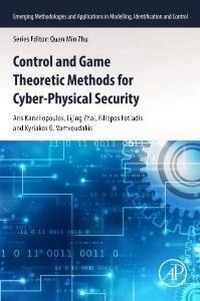
Control and Game Theoretic Methods for Cyber-Physical Security
Published on 30. May 2024
Book
Paperback/Softback
198 pages
978-0-443-15408-9 (ISBN)
Description
Control-Theoretic Methods for Cyber-Physical Security presents novel results on security and defense methodologies applied to cyber-physical systems. This book takes a control and game theory perspective, treating autonomous platforms as dynamic systems. It introduces algorithmic frameworks designed to proactively and reactively safeguard these systems against catastrophic failures. The algorithms showcased encompass a wide spectrum of security techniques, from model-free detection mechanisms to unpredictability-based defense strategies, combining both model-based and data-driven approaches.
More details
Series
Language
English
Place of publication
San Diego
United States
Publishing group
Elsevier Science Publishing Co Inc
Target group
Professional and scholarly
Product notice
Paperback (trade)
Unsewn / adhesive bound
Dimensions
Height: 232 mm
Width: 156 mm
Thickness: 18 mm
Weight
318 gr
ISBN-13
978-0-443-15408-9 (9780443154089)
Copyright in bibliographic data and cover images is held by Nielsen Book Services Limited or by the publishers or by their respective licensors: all rights reserved.
Schweitzer Classification
Other editions
Additional editions
Aris Kanellopoulos | Lijing Zhai | Filippos Fotiadis
Control and Game Theoretic Methods for Cyber-Physical Security
E-Book
05/2024
Academic Press
€130.00
Available for download
Persons
Aris Kanellopoulos received his diploma equivalent to a Master of Science in Mechanical Engineering from the National Technical University of Athens, Greece, in 2017. He studied at the Kevin T. Crofton Department of Aerospace and Ocean Engineering at Virginia Tech and was awarded a PhD in Aerospace Engineering at the Georgia Institute of Technology. In 2022 he was a Research Engineer within Professor Kyriakos G. Vamvoudakis' group. He is currently a Postdoctoral Researcher with the Division of Information Science and Engineering at the Royal Institute of Technology, Sweden.
Lijing Zhai received her MS in Power Engineering and Engineering Thermophysics from Beihang University, Beijing, China, in 2018. She is currently working toward a PhD degree at the Guggenheim School of Aerospace Engineering, Georgia Institute of Technology, Atlanta, USA. Her current research interests include cyber-physical security, optimal and learning-based control.
Filippos Fotiadis was born in Thessaloniki, Greece. He received the Diploma (joint B.Sc. and M.Sc. degree) in Electrical and Computer Engineering from the Aristotle University of Thessaloniki, Greece, in 2018. He is currently pursuing the Ph.D. degree in Aerospace Engineering at the Georgia Institute of Technology, where he also obtained the M.Sc. degree in Aerospace Engineering in 2022, and the M.Sc. degree in Mathematics in 2023. His research interests include optimal and learning-based control, game theory, and their applications to cyber-physical security, as well as prescribed performance control.
Kyriakos G. Vamvoudakis is the Dutton-Ducoffe Endowed Professor at The Daniel Guggenheim School of Aerospace Engineering at Georgia Tech. He holds a secondary appointment in the School of Electrical and Computer Engineering. His expertise is in reinforcement learning, control theory, game theory, cyber-physical security, bounded rationality, and safe/assured autonomy.He has served on various international program committees and has organized several international conferences. He currently is a member of the Technical Committee on Intelligent Control of the IEEE Control Systems Society, a member of the Technical Committee on Adaptive Dynamic Programming and Reinforcement Learning of the IEEE Computational Intelligence Society, a member of the IEEE Control Systems Society Conference Editorial Board, an Associate Editor of: Automatica; IEEE Transactions on Automatic Control; IEEE Transactions on Neural Networks and Learning Systems; IEEE Computational Intelligence Magazine; IEEE Transactions on Systems, Man, and Cybernetics: Systems; IEEE Transactions on Artificial Intelligence; Neurocomputing; Journal of Optimization Theory and Applications; and of Frontiers in Control Engineering-Adaptive, Robust and Fault Tolerant Control. He had also served as a Guest Editor for, IEEE Transactions on Automation Science and Engineering (Special issue on Learning from Imperfect Data for Industrial Automation); IEEE Transactions on Neural Networks and Learning Systems (Special issue on Reinforcement Learning Based Control: Data-Efficient and Resilient Methods); IEEE Transactions on Industrial Informatics (Special issue on Industrial Artificial Intelligence for Smart Manufacturing); and IEEE Transactions on Intelligent Transportation Systems (Special issue on Unmanned Aircraft System Traffic Management). He is also a registered Electrical/Computer engineer (PE), a member of the Technical Chamber of Greece, an Associate Fellow of AIAA, and a Senior Member of IEEE.
Lijing Zhai received her MS in Power Engineering and Engineering Thermophysics from Beihang University, Beijing, China, in 2018. She is currently working toward a PhD degree at the Guggenheim School of Aerospace Engineering, Georgia Institute of Technology, Atlanta, USA. Her current research interests include cyber-physical security, optimal and learning-based control.
Filippos Fotiadis was born in Thessaloniki, Greece. He received the Diploma (joint B.Sc. and M.Sc. degree) in Electrical and Computer Engineering from the Aristotle University of Thessaloniki, Greece, in 2018. He is currently pursuing the Ph.D. degree in Aerospace Engineering at the Georgia Institute of Technology, where he also obtained the M.Sc. degree in Aerospace Engineering in 2022, and the M.Sc. degree in Mathematics in 2023. His research interests include optimal and learning-based control, game theory, and their applications to cyber-physical security, as well as prescribed performance control.
Kyriakos G. Vamvoudakis is the Dutton-Ducoffe Endowed Professor at The Daniel Guggenheim School of Aerospace Engineering at Georgia Tech. He holds a secondary appointment in the School of Electrical and Computer Engineering. His expertise is in reinforcement learning, control theory, game theory, cyber-physical security, bounded rationality, and safe/assured autonomy.He has served on various international program committees and has organized several international conferences. He currently is a member of the Technical Committee on Intelligent Control of the IEEE Control Systems Society, a member of the Technical Committee on Adaptive Dynamic Programming and Reinforcement Learning of the IEEE Computational Intelligence Society, a member of the IEEE Control Systems Society Conference Editorial Board, an Associate Editor of: Automatica; IEEE Transactions on Automatic Control; IEEE Transactions on Neural Networks and Learning Systems; IEEE Computational Intelligence Magazine; IEEE Transactions on Systems, Man, and Cybernetics: Systems; IEEE Transactions on Artificial Intelligence; Neurocomputing; Journal of Optimization Theory and Applications; and of Frontiers in Control Engineering-Adaptive, Robust and Fault Tolerant Control. He had also served as a Guest Editor for, IEEE Transactions on Automation Science and Engineering (Special issue on Learning from Imperfect Data for Industrial Automation); IEEE Transactions on Neural Networks and Learning Systems (Special issue on Reinforcement Learning Based Control: Data-Efficient and Resilient Methods); IEEE Transactions on Industrial Informatics (Special issue on Industrial Artificial Intelligence for Smart Manufacturing); and IEEE Transactions on Intelligent Transportation Systems (Special issue on Unmanned Aircraft System Traffic Management). He is also a registered Electrical/Computer engineer (PE), a member of the Technical Chamber of Greece, an Associate Fellow of AIAA, and a Senior Member of IEEE.
Author
Research Engineer, Georgia Institute of Technology, Atlanta, GA, USA
Ph.D. degree with Professor Kyriakos G. Vamvoudakis at the Guggenheim School of Aerospace Engineering, Georgia Institute of Technology, Atlanta, GA, USA.
The Daniel Guggenheim School of Aerospace Engineering, Georgia Institute of Technology, USA
Dutton-Ducoffe Endowed Professor, Georgia Institute of Technology, GA, USA
Content
1. Introduction
2. Control-theoretic intrusion detection
3. Redundancy-based defense
4. Timing Faults and Attacks
5. Adversarial Modelling
6. Future Research Directions
2. Control-theoretic intrusion detection
3. Redundancy-based defense
4. Timing Faults and Attacks
5. Adversarial Modelling
6. Future Research Directions