

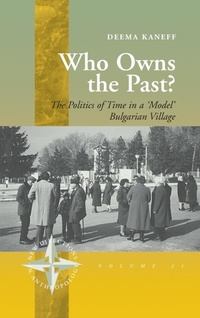
Who Owns the Past?
The Politics of Time in a 'Model' Bulgarian Village
1st Edition
Published on 1. January 2004
Book
Hardback
240 pages
978-1-57181-534-7 (ISBN)
Description
In the decades since the collapse of socialism in eastern Europe, time has been a central resource under negotiation. Focusing on a local community that was considered a "model" in the socialist period, the author explores a variety of state-sponsored and unofficial pasts - history, folklore, and tradition - and shows how they "fit" together in everyday life. During the socialist period, the past was a central dimension of local politics and village identity. Post-socialist development has demanded a revaluation of temporality - as well as public and private space. This has led to fundamental changes in social life and political relations, reduced local resources, threatened village identity and transformed political activity through the emergence of new political elites.
While the full implications of this process are still being played out, this study underlines some of the fundamental processes prevalent across eastern Europe that help explain widespread ambiguity vis-B-vis post-socialist reform.
While the full implications of this process are still being played out, this study underlines some of the fundamental processes prevalent across eastern Europe that help explain widespread ambiguity vis-B-vis post-socialist reform.
Reviews / Votes
"It is an intelligent idea to look at society in terms of competing renditions of the past, and this can be rewarding for studies of other than socialist societies...The book demonstrates the significance of meaning for state formation." ? Focaal"...the book is an intelligent reading of rural socialist Bulgaria; it demonstrates the significance of meaning for state formation in general and places the artifacts of humanities, history tradition, and folklore right at the center of political science." ? Focaal
"...a welcome addition to the literature on the relationship between politics and history in the rural areas of socialist Bulgaria...The book masterfully explains how the official socialist version of local history was created and disseminated through life history narratives, ceremonies, awards and textbooks...The book is very readable and could be successfully used in undergraduate classes." ? JRAI
More details
Series
Language
English
Place of publication
Herndon
United States
Product notice
Library binding
Illustrations
Bibliography; Index
Dimensions
Height: 235 mm
Width: 157 mm
Thickness: 17 mm
Weight
501 gr
ISBN-13
978-1-57181-534-7 (9781571815347)
DOI
10.3167/9781571815347
Copyright in bibliographic data and cover images is held by Nielsen Book Services Limited or by the publishers or by their respective licensors: all rights reserved.
Schweitzer Classification
Other editions
Additional editions
E-Book
10/2006
1st Edition
Berghahn Books
€26.99
Available for download
Person
Deema Kaneff is reader in Social Anthropology at the Centre for Russian, European and Eurasian Studies at the University of Birmighnam.
Content
Acknowledgements
Abbreviations
Glossary
Chapter 1. Introduction: Politics and the past
Local-Centre Relations in Socialist Bulgaria
Socialist Temporality
The Importance of the Past: History, Tradition and Folklore
Fieldwork and the Issue of Representation
Chapter 2. A 'Model Village'
The 'Model Village'
Event Administrative Relations
Class Relations
Morality
Identity
Conclusion
HISTORY: A BRIEF INTRODUCTION TO CHAPTERS 3 AND 4
Chapter 3. Socialist History, Politics and Morality
Characterising History
Politics and History
A Moral History
Chapter 4. Contesting History
Different Histories: Political Pluralism
Alliances and Oppositions
TRADITION: A BRIEF INTRODUCTION TO CHAPTERS 5 AND 6
Chapter 5. The Character of Traditions
Traditional Funeral Practices
Death and Relations to Nature
Collective Celebrations of Tradition
Chapter 6. Tradition and History: Contrasting Constructions of the Past
A Good Communist Village: A Bad Traditional Village
Creating Local Distinctions: Traditional Practices as a Way of Opposing the State
FOLKLORE: A BRIEF INTRODUCTION TO CHAPTERS 7 AND 8
Chapter 7. Defining Folklore
Survakani: both a Traditional and Folkloric Custom
Folklore as a State-determined Activity
Chapter 8. Folklore in a New Bulgarian Village
Education, Bulgarian Culture and Folklore
The Village Vocal Group
Talpa - a 'new Bulgarian village'
Chapter 9. A New Model for the Village
A Model Village in a Model District
Decentralisation - the Tragic Consequences
A Re-evalutaion of the Past
Re-negotiating Relations with the Centre
Appendix I: 9 September 1987
Appendix II: Eulogy
References
Index
Abbreviations
Glossary
Chapter 1. Introduction: Politics and the past
Local-Centre Relations in Socialist Bulgaria
Socialist Temporality
The Importance of the Past: History, Tradition and Folklore
Fieldwork and the Issue of Representation
Chapter 2. A 'Model Village'
The 'Model Village'
Event Administrative Relations
Class Relations
Morality
Identity
Conclusion
HISTORY: A BRIEF INTRODUCTION TO CHAPTERS 3 AND 4
Chapter 3. Socialist History, Politics and Morality
Characterising History
Politics and History
A Moral History
Chapter 4. Contesting History
Different Histories: Political Pluralism
Alliances and Oppositions
TRADITION: A BRIEF INTRODUCTION TO CHAPTERS 5 AND 6
Chapter 5. The Character of Traditions
Traditional Funeral Practices
Death and Relations to Nature
Collective Celebrations of Tradition
Chapter 6. Tradition and History: Contrasting Constructions of the Past
A Good Communist Village: A Bad Traditional Village
Creating Local Distinctions: Traditional Practices as a Way of Opposing the State
FOLKLORE: A BRIEF INTRODUCTION TO CHAPTERS 7 AND 8
Chapter 7. Defining Folklore
Survakani: both a Traditional and Folkloric Custom
Folklore as a State-determined Activity
Chapter 8. Folklore in a New Bulgarian Village
Education, Bulgarian Culture and Folklore
The Village Vocal Group
Talpa - a 'new Bulgarian village'
Chapter 9. A New Model for the Village
A Model Village in a Model District
Decentralisation - the Tragic Consequences
A Re-evalutaion of the Past
Re-negotiating Relations with the Centre
Appendix I: 9 September 1987
Appendix II: Eulogy
References
Index