

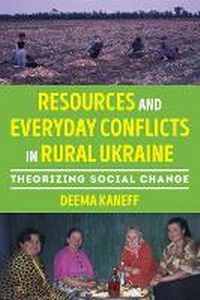
Resources and Everyday Conflicts in Rural Ukraine
Theorizing Social Change
Will be published approx. on 16. December 2025
Book
Hardback
300 pages
978-0-8229-4877-3 (ISBN)
Description
Social change is a topic of central interest in the social sciences. The upheavals and reforms that swept across former socialist states in Eurasia offer a rich array of case studies to deepen our understanding of this phenomenon. Based on ethnographic fieldwork in an ethnically Bulgarian community in rural Ukraine, Kaneff uniquely brings to light a range of hidden conflicts and everyday tensions, as well as new alliances and solidarities resulting from the redistribution of resources following Ukrainian independence. A focus on five key resources provides a means to explore the way in which relationships have been contested and renegotiated in this small community, with implications that go far beyond those boundaries.
Reviews / Votes
When the Bulgarian minority in Bessarabia was exposed to the dual forces of globalizing political economy and the nationalizing Ukrainian state, life-worlds and resource use changed radically. Kaneff's study is both an important addition to the literature on postsocialist transformation and, with its sophisticated conceptualization of resources, a truly original contribution to the analysis of social change generally. -- Chris Hann, Max Planck Institute for Social Anthropology In this finely grained, historically grounded ethnographic study of a village in Ukraine, Deema Kaneff focuses on resources-economic, social, material, and immaterial-as the core of her theoretical approach to social change. Resources may have use value, exchange value, or both, and may change and fluctuate according to context, political circumstance, and economic shifts. Kaneff examines different kinds of resources, ranging from land and water to identity, ethnicity, and language, as they move from a position of use and consumption to exchange value, or gain monetary value. She describes the changes in political economy and social relations of the ethnically Bulgarian village prior to and throughout the Soviet period, through the collapse of the Soviet Union, and with establishment of an independent Ukraine. Her last fieldwork in the village was in 2014, the beginning of the first Russian invasion, but the ensuing war is foreshadowed in discussions of increasing Ukrainian nationalism and exclusions based on ethnic identity and language. Kaneff paints a vivid portrait of a village reacting to, and being deeply changed by, events in the wider world-the end of the Soviet Union, economic restructuring, changing national and global markets, migration, new inequalities, and war. But it also tells a story of resilience, of adaptation to change, and of new possibilities opening through education, mobility, and networks of kinship and friendship. -- Frances Pine, Goldsmiths, University of LondonMore details
Language
English
Place of publication
Pittsburgh PA
United States
Target group
Professional and scholarly
Dimensions
Height: 229 mm
Width: 152 mm
ISBN-13
978-0-8229-4877-3 (9780822948773)
Copyright in bibliographic data and cover images is held by Nielsen Book Services Limited or by the publishers or by their respective licensors: all rights reserved.
Schweitzer Classification
Person
Deema Kaneff is a reader in social anthropology at the University of Birmingham in the UK and an associate at the Max Planck Institute for Social Anthropology in Halle, Germany. She is the series editor for the book series Anthropologies of Eurasia: Ethnographic Encounters of Social Change and a member of the editorial board for the book series European Studies in Socio-Cultural Anthropology and Ethnology. She is the author of Who Owns the Past? The Politics of Time in a "Model" Bulgarian Village, as well as numerous other edited volumes and journal publications.