

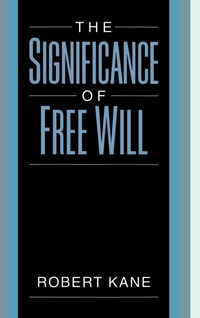
The Significance of Free Will
Published on 23. January 1997
Book
Hardback
280 pages
978-0-19-510550-6 (ISBN)
Description
Kane offers a provocative and original account of the issues surrounding free will and moral responsibility. He presents a version of the "incompatibilist" or "libertarian" view of free will, defending the classic view of free will as "the power of agents to be the ultimate creators and sustainers of their own ends and purposes" against a wide range of modern critics. This book also serves as a comprehensive survey of recent controversies about free will, covering most of the debates of the past 25 years.
Reviews / Votes
Kane furnishes his reader with a uniformly illuminating tour through the labyrinths of the free will debate. A careful reader of Kane can return to the philosophical literature with greater understanding and profit. David M. Ciocchi, Philosophia Christi, Vol.1, No.2, 1999 His complex and carefully argued book ... is the culmination of twenty-five years of thought on the matter ... How successful is Kane in providing an account of freedom of the will is both adequate and to our pre-theoretical understanding and yet consonant with physical theorizing? In my judgement, he has gone farther than any other philosopher working within the constraint of making no basic ontological posits concerning only persons and their capacities. * Times Literary Supplement *More details
Language
English
Place of publication
New York
United States
Target group
Professional and scholarly
Dimensions
Height: 235 mm
Width: 157 mm
Thickness: 21 mm
Weight
609 gr
ISBN-13
978-0-19-510550-6 (9780195105506)
Copyright in bibliographic data and cover images is held by Nielsen Book Services Limited or by the publishers or by their respective licensors: all rights reserved.
Schweitzer Classification
Other editions
Additional editions

Robert Kane
The Significance of Free Will
Book
03/1999
Oxford University Press Inc
€115.70
Shipment within 15-20 days


Person
Content
I. THE ASCENT PROBLEM:COMPATIBILITY AND SIGNIFICANCE; II. THE DESCENT PROBLEM: INTELLIGIBILITY AND EXISTENCE