

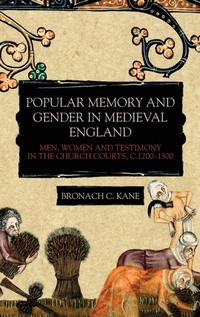
Popular Memory and Gender in Medieval England
Men, Women, and Testimony in the Church Courts, c.1200-1500
Will be published approx. on 24. May 2019
Book
Hardback
309 pages
978-1-78327-352-2 (ISBN)
Description
An exploration of the influence of gender on the workings of memory in the Middle Ages, focussing on the non-elite.
WINNER of the Women's History Network 2020 Book Prize
Church court records offer the most detailed records of everyday life in medieval England for people below the level of the elite. Vivid testimony in cases of marriage, insult, and debt, as well as tithes, testaments and ecclesiastical rights, show how men and women thought about the past and presented their own histories.
While previous studies of memory in this period have tended to explore formal memory techniques in the schools and monasteries, this book turns to lay contexts instead, considering for the first time how gender influenced the ways that "ordinary" men and women remembered past events in the centuries leading up to the Reformations. Drawing on legal depositions, supplemented by pastoralia, literature and lyrics, the author argues that despite the many constraints upon their actions, lower-status men and women could use the law to communicate complex and varied pasts. She addresses the legal and religious developments that generated these memories, charting how gender shaped depictions of courtship, sexuality and childbirth, marriage and widowhood,as well as custom and the landscape. The book analyses these themes through the lens of gender and subjectivity, challenging conventional narratives that have aligned female remembrance with domesticity while embedding male memory in the public sphere. This approach offers precious evidence of the gendered, moral, and emotional worlds of lower-status people in medieval England.
BRONACH C. KANE is Lecturer in Medieval History at Cardiff University.
WINNER of the Women's History Network 2020 Book Prize
Church court records offer the most detailed records of everyday life in medieval England for people below the level of the elite. Vivid testimony in cases of marriage, insult, and debt, as well as tithes, testaments and ecclesiastical rights, show how men and women thought about the past and presented their own histories.
While previous studies of memory in this period have tended to explore formal memory techniques in the schools and monasteries, this book turns to lay contexts instead, considering for the first time how gender influenced the ways that "ordinary" men and women remembered past events in the centuries leading up to the Reformations. Drawing on legal depositions, supplemented by pastoralia, literature and lyrics, the author argues that despite the many constraints upon their actions, lower-status men and women could use the law to communicate complex and varied pasts. She addresses the legal and religious developments that generated these memories, charting how gender shaped depictions of courtship, sexuality and childbirth, marriage and widowhood,as well as custom and the landscape. The book analyses these themes through the lens of gender and subjectivity, challenging conventional narratives that have aligned female remembrance with domesticity while embedding male memory in the public sphere. This approach offers precious evidence of the gendered, moral, and emotional worlds of lower-status people in medieval England.
BRONACH C. KANE is Lecturer in Medieval History at Cardiff University.
Reviews / Votes
This very impressive and well-researched book was a worthy winner of the Women's History Network 2020 book prize and fills gaps in the knowledge of the importance of women in medieval society. * FACHRS * This is a work of exceptional scholarship and deserves to be widely read. * THE JOURNAL OF ECCLESIASTICAL HISTORY * Well-structured and accessible * NOTTINGHAM MEDIEVAL STUDIES * A richly detailed social history that displays a deep sensitivity to its subjects' world-views....it signals future directions for studies that seek to uncover the memories of non-elite people in the medieval world. * AGRICULTURAL HISTORY REVIEW * A fascinating subject, deftly handled. * JOURNAL OF BRITISH STUDIES * The book's rich contents outline a multilayered vision of the period, in which memory became increasingly important for the sacrament of confession, with penitents urged to remember their sins and the circumstances surrounding them. Recommended. * CHOICE * [Terrific . . . Drawing on legal, medical, social, and gender studies, Kane looks not at theories of how memory was supposed to work but how memories were put into practice. In exploring how ordinary people applied the memory practices they were taught, Kane deftly demonstrates how they operated in the world. -- Katherine L. French * Speculum * A rewarding piece of work with lots of intelligent insights hidden within its larger argument.... This book is a must read for historians of any period interested in these themes, or just for those looking for a pleasurable escape into the lives of lower-order medieval families. * PARERGON * The book would be a valuable asset in any class examining medieval memorial and legal cultures and their relationship to class, and I could easily see its inclusion in a diverse array of undergraduate and graduate courses ... I also think the book could provide an excellent example of how archives can provide valuable qualitative and quantitative data and narratives, and I would recommend its inclusion in an interdisciplinary medieval course, especially those examining popular culture, memory and the daily involvement of the church in everyday lives. * STUDIES IN MEDIEVAL AND RENAISSANCE TEACHING *More details
Series
Language
English
Place of publication
Woodbridge
United Kingdom
Publishing group
Boydell & Brewer Ltd
Target group
Professional and scholarly
Product notice
Cloth over boards
Dimensions
Height: 240 mm
Width: 161 mm
Thickness: 21 mm
Weight
637 gr
ISBN-13
978-1-78327-352-2 (9781783273522)
Copyright in bibliographic data and cover images is held by Nielsen Book Services Limited or by the publishers or by their respective licensors: all rights reserved.
Schweitzer Classification
Other editions
Additional editions
Bronach Kane
Popular Memory and Gender in Medieval England
Men, Women, and Testimony in the Church Courts, c.1200-1500
Book
06/2021
Boydell Press
€37.70
Shipment within 3-4 weeks
Bronach Kane
Popular Memory and Gender in Medieval England
Men, Women, and Testimony in the Church Courts, c.1200-1500
E-Book
05/2019
1st Edition
De Gruyter
€48.99
Available for download
Person
BRONACH C. KANE is Lecturer in Medieval History at Cardiff University.
Content
Introduction
Pastoral Care, Canon Law, and Social Relations
Gender, Narrative, and Testimony
Bodily Practices
Sexuality and Generation
Marriage, Kinship, and Widowhood
Orality, Written Memory, and Custom
Place, Landscape, and Gender
Conclusion
Bibliography
Pastoral Care, Canon Law, and Social Relations
Gender, Narrative, and Testimony
Bodily Practices
Sexuality and Generation
Marriage, Kinship, and Widowhood
Orality, Written Memory, and Custom
Place, Landscape, and Gender
Conclusion
Bibliography