

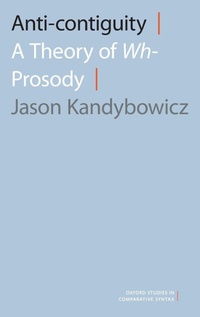
Anti-contiguity
A Theory of Wh- Prosody
Published on 15. December 2020
Book
Hardback
172 pages
978-0-19-750973-9 (ISBN)
Description
A recent wave of research has explored the link between wh- syntax and prosody, breaking with the traditional generative conception of a unidirectional syntax-phonology relationship. In this book, Jason Kandybowicz develops Anti-contiguity Theory as a compelling alternative to Richards' Contiguity Theory to explain the interaction between the distribution of interrogative expressions and the prosodic system of a language. Through original and highly detailed fieldwork on several under-studied West African languages (Krachi, Bono, Wasa, Asante Twi, and Nupe), Kandybowicz presents empirically and theoretically rich analyses bearing directly on a number of important theories of the syntax-prosody interface. His observations and analyses stem from original fieldwork on all five languages and represent some of the first prosodic descriptions of the languages. The book also considers data from thirteen additional typologically diverse languages to demonstrate the theory's reach and extendibility.
Against the backdrop of data from eighteen languages, Anti-contiguity offers a new lens on the empirical and theoretical study of wh- prosody.
Against the backdrop of data from eighteen languages, Anti-contiguity offers a new lens on the empirical and theoretical study of wh- prosody.
Reviews / Votes
This book is a very welcome contribution to research on the syntax-phonology interface. Empirically, it explores in depth a wealth of prosodic and syntactic data from lesser-described West African languages, and theoretically, it raises a number of important and challenging questions which will help guide future research. The approach taken in this work investigates core issues at the syntax-prosody interface in a way that engages seriously with insights from diverse subfields, including phonetics, phonology, prosody, syntax, and the syntax-phonology interface. * Emily Elfner, York University *More details
Series
Language
English
Place of publication
New York
United States
Target group
Professional and scholarly
Dimensions
Height: 240 mm
Width: 161 mm
Thickness: 14 mm
Weight
429 gr
ISBN-13
978-0-19-750973-9 (9780197509739)
Copyright in bibliographic data and cover images is held by Nielsen Book Services Limited or by the publishers or by their respective licensors: all rights reserved.
Schweitzer Classification
Other editions
Additional editions
Book
12/2020
Oxford University Press Inc
€69.60
Shipment within 15-20 days
E-Book
10/2020
OUP eBook
€30.49
Available for download
E-Book
10/2020
OUP eBook
€30.49
Available for download
Person
Jason Kandybowicz is Associate Professor of Linguistics at The Graduate Center, City University of New York. He specializes in the syntax of West African languages and has published extensively on a variety of topics in formal syntax, field linguistics, and the syntax-phonology interface. He is the author of The Grammar of Repetition: Nupe Grammar at the Syntax-Phonology Interface (2008) and co-editor of Africa's Endangered Languages: Documentary and Theoretical Approaches (OUP 2017).
Content
List of Abbreviations Used in Non-Cited Data
Acknowledgments
Map of Languages Covered in This Book
Chapter 1: Introduction
Chapter 2: Prosodic Entanglement and the Anti-Contiguity of Wh & C.
Chapter 3: An Anti-Contiguity Approach to Tano In-Situ Interrogative Distribution
Chapter 4: An Anti-Contiguity Approach to Nupe Interrogative Distribution
Chapter 5: Anti-Contiguity Cross-Linguistically
References.
Acknowledgments
Map of Languages Covered in This Book
Chapter 1: Introduction
Chapter 2: Prosodic Entanglement and the Anti-Contiguity of Wh & C.
Chapter 3: An Anti-Contiguity Approach to Tano In-Situ Interrogative Distribution
Chapter 4: An Anti-Contiguity Approach to Nupe Interrogative Distribution
Chapter 5: Anti-Contiguity Cross-Linguistically
References.