

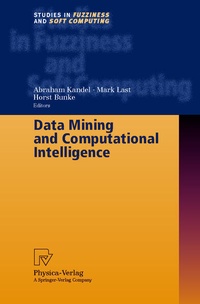
Data Mining and Computational Intelligence
Published on 13. March 2001
Book
Hardback
XII, 356 pages
978-3-7908-1371-5 (ISBN)
Description
Many business decisions are made in the absence of complete information about the decision consequences. Credit lines are approved without knowing the future behavior of the customers; stocks are bought and sold without knowing their future prices; parts are manufactured without knowing all the factors affecting their final quality; etc. All these cases can be categorized as decision making under uncertainty. Decision makers (human or automated) can handle uncertainty in different ways. Deferring the decision due to the lack of sufficient information may not be an option, especially in real-time systems. Sometimes expert rules, based on experience and intuition, are used. Decision tree is a popular form of representing a set of mutually exclusive rules. An example of a two-branch tree is: if a credit applicant is a student, approve; otherwise, decline. Expert rules are usually based on some hidden assumptions, which are trying to predict the decision consequences. A hidden assumption of the last rule set is: a student will be a profitable customer. Since the direct predictions of the future may not be accurate, a decision maker can consider using some information from the past. The idea is to utilize the potential similarity between the patterns of the past (e.g., "most students used to be profitable") and the patterns of the future (e.g., "students will be profitable").
More details
Series
Edition
2001 ed.
Language
English
Place of publication
Heidelberg
Germany
Target group
Professional and scholarly
Research
Illustrations
XII, 356 p.
Dimensions
Height: 241 mm
Width: 160 mm
Thickness: 25 mm
Weight
723 gr
ISBN-13
978-3-7908-1371-5 (9783790813715)
DOI
10.1007/978-3-7908-1825-3
Schweitzer Classification
Other editions
Additional editions
Abraham Kandel | Mark Last | Horst Bunke
Data Mining and Computational Intelligence
Book
10/2010
Physica
€160.49
Shipment within 10-15 days
Content
Data Mining with Neuro-Fuzzy Models.- Granular Computing in Data Mining.- Fuzzification and Reduction of Information - Theoretic Rule Sets.- Mining Fuzzy Association Rules in a Database Containing Relational and Transactional Data.- Fuzzy Linguistics Summaries via Association Rules.- The Fuzzy-ROSA Method: A Statistically Motivated Fuzzy Approach for Data-Based Generation of Small Interpretable Rule Bases in High-Dimensional Search Spaces.- Discovering Knowledge from Fuzzy Concept Lattice.- Mining of Labeled Incomplete Data Using Fast Dimension Partitioning.- Mining a Growing Feature Map by Data Skeleton Modelling.- Soft Regression - A Data Mining Tool.- Some Practical Applications of Soft Computing and Data Mining.- Intelligent Mining in Image Databases, with Applications to Satellite Imaging and to Web Search.- Fuzzy Genetic Modeling and Forecasting for Nonlinear Time Series.