

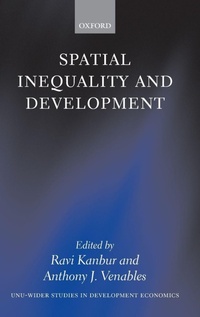
Spatial Inequality and Development
Published on 3. February 2005
Book
Hardback
440 pages
978-0-19-927863-3 (ISBN)
Description
What exactly is spatial inequality? Why does it matter? And what should be the policy response to it? These questions have become important in recent years as the spatial dimensions of inequality have begun to attract considerable policy interest. In China, Russia, India, Mexico, and South Africa, as well as most other developing and transition economies, spatial and regional inequality - of economic activity, incomes, and social indicators - is on the increase.
Spatial inequality is a dimension of overall inequality, but it has added significance when spatial and regional divisions align with political and ethnic tensions to undermine social and political stability. Also important in the policy debate is a perceived sense that increasing internal spatial inequality is related to greater openness of economies, and to globalization in general.
Despite these important concerns, there is remarkably little systematic documentation of what has happened to spatial and regional inequality over the last twenty years. Correspondingly, there is insufficient understanding of the determinants of internal spatial inequality.
This volume attempts to answer the questions posed above, drawing on data from twenty-five countries from all regions of the world. They bring together perspectives and expertise in development economics and in economic geography and form a well-researched introduction to an area of growing analytical and policy importance.
Spatial inequality is a dimension of overall inequality, but it has added significance when spatial and regional divisions align with political and ethnic tensions to undermine social and political stability. Also important in the policy debate is a perceived sense that increasing internal spatial inequality is related to greater openness of economies, and to globalization in general.
Despite these important concerns, there is remarkably little systematic documentation of what has happened to spatial and regional inequality over the last twenty years. Correspondingly, there is insufficient understanding of the determinants of internal spatial inequality.
This volume attempts to answer the questions posed above, drawing on data from twenty-five countries from all regions of the world. They bring together perspectives and expertise in development economics and in economic geography and form a well-researched introduction to an area of growing analytical and policy importance.
Reviews / Votes
This book, edited by two internationally recognized leaders in development economics and economic geography ... is highly recommended to scholars within peace research - especially those working on distributional issues and violent conflict. * Journal of Peace Research * This volume will be useful to the scholarly community. * Journal of Peace Research May 2006 *More details
Series
Language
English
Place of publication
Oxford
United Kingdom
Target group
Professional and scholarly
Illustrations
numerous figures and tables
Dimensions
Height: 240 mm
Width: 161 mm
Thickness: 28 mm
Weight
819 gr
ISBN-13
978-0-19-927863-3 (9780199278633)
Copyright in bibliographic data and cover images is held by Nielsen Book Services Limited or by the publishers or by their respective licensors: all rights reserved.
Schweitzer Classification
Other editions
Additional editions
Ravi Kanbur | Anthony J. Venables
Spatial Inequality and Development
E-Book
02/2005
1st Edition
OUP eBook
€144.99
Available for download
Persons
Ravi Kanbur is T.H. Lee Professor of World Affairs and Professor of Economics at Cornell University and has been Professor of Economics at the University of Warwick and Chief Economist for Africa at the World Bank.
Anthony J. Venables is Professor of International Economics at the London School of Economics and has been Professor of Economics at the University of Southampton and Trade Research Manager at the World Bank.
Anthony J. Venables is Professor of International Economics at the London School of Economics and has been Professor of Economics at the University of Southampton and Trade Research Manager at the World Bank.
Content
1. Introduction ; 2. Regional Output Differences in International Perspective ; 3. Are Neighbors Equal? Estimating Local Inequality in Three Developing Countries ; 4. Market Size, Linkages and Productivity: A Study of Japanese Regions ; 5. Externalities in Rural Development: Evidence for China ; 6. Opening the Convergence Black Box: Measurement Problems and Demographic Aspects ; 7. Adverse Geography and Differences in Welfare in Peru ; 8. How Responsive is Poverty to Growth? A Regional Analysis of Poverty, Inequality and Growth in Indonesia, 1984-1999 ; 9. Reforms, Remoteness and Risk in Africa: Understanding Inequality and Poverty During the 1990s ; 10. Economic Polarization Through Trade: Trade Liberalization and Regional Growth in Mexico ; 11. International Trade, Location and Wage inequality in China ; 12. Spatial Inequality for Manufacturing Wages in Five African Countries ; 13. Regional Poverty and Income Inequality in Central and Eastern Europe: Evidence from the Luxembourg Income Study ; 14. Quo Vadis: Inequality and Poverty Dynamics Across Russian Regions