

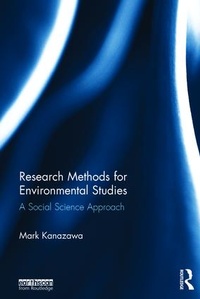
Research Methods for Environmental Studies
A Social Science Approach
1st Edition
Published on 17. October 2017
Book
Hardback
380 pages
978-1-138-68016-6 (ISBN)
Description
The methodological needs of environmental studies are unique in the breadth of research questions that can be posed, calling for a textbook that covers a broad swath of approaches to conducting research with potentially many different kinds of evidence.
Written specifically for social science-based research into the environment, this book covers the best-practice research methods most commonly used to study the environment and its connections to societal and economic activities and objectives. Over five key parts, Kanazawa introduces quantitative and qualitative approaches, mixed methods, and the special requirements of interdisciplinary research, emphasizing that methodological practice should be tailored to the specific needs of the project. Within these parts, detailed coverage is provided on key topics including the identification of a research project; spatial analysis; ethnography approaches; interview technique; and ethical issues in environmental research.
Drawing on a variety of extended examples to encourage problem-based learning and fully addressing the challenges associated with interdisciplinary investigation, this book will be an essential resource for students embarking on courses exploring research methods in environmental studies.
Written specifically for social science-based research into the environment, this book covers the best-practice research methods most commonly used to study the environment and its connections to societal and economic activities and objectives. Over five key parts, Kanazawa introduces quantitative and qualitative approaches, mixed methods, and the special requirements of interdisciplinary research, emphasizing that methodological practice should be tailored to the specific needs of the project. Within these parts, detailed coverage is provided on key topics including the identification of a research project; spatial analysis; ethnography approaches; interview technique; and ethical issues in environmental research.
Drawing on a variety of extended examples to encourage problem-based learning and fully addressing the challenges associated with interdisciplinary investigation, this book will be an essential resource for students embarking on courses exploring research methods in environmental studies.
Reviews / Votes
"This book provides a holistic approach to research methods in environmental studies by looking into the epistemological underpinnings of contemporary issues in environmental studies. The contents are comprehensive; and the examples and case studies apt. Students in environmental studies will find the book a useful toolkit to reflect on how best to design research projects." - Girma Zawdie, University of Strathclyde, UKMore details
Language
English
Place of publication
London
United Kingdom
Publishing group
Taylor & Francis Ltd
Target group
College/higher education
Illustrations
70 s/w Zeichnungen, 5 s/w Tabellen, 91 s/w Abbildungen, 16 s/w Photographien bzw. Rasterbilder
5 Tables, black and white; 70 Line drawings, black and white; 16 Halftones, black and white; 91 Illustrations, black and white
Dimensions
Height: 234 mm
Width: 156 mm
Weight
707 gr
ISBN-13
978-1-138-68016-6 (9781138680166)
Copyright in bibliographic data and cover images is held by Nielsen Book Services Limited or by the publishers or by their respective licensors: all rights reserved.
Schweitzer Classification
Other editions
New editions
Book
07/2023
2nd Edition
Routledge
€208.20
Shipment within 10-20 days
Additional editions
Book
10/2017
1st Edition
Routledge
€78.27
Article exhausted; check for reprint
Person
Mark Kanazawa is a Professor of Economics at Carleton University, the United States. He has also held visiting positions at Stanford, UC-Berkeley, and the University of Illinois, and he has been awarded the Jacobs Fellowship at the Huntington Library and the Simon Fellowship at the Property and Environment Research Center. Kanazawa has published research in the areas of American economic history, law and economics, new institutional economics, water policy, economics of sports, and the economics of natural resources. He teaches courses in environmental and natural resource economics, western economic history, economics of sports, econometrics, and research methods in environmental studies.
Content
Chapter 1: Introduction to research methods in environmental studies
Chapter 2: A brief history of knowledge and argumentation
Chapter 3: General research design principles
Chapter 4: General principles of quantitative research
Chapter 5: Quantitative data and sampling
Chapter 6: Basic quantitative methods and analysis
Chapter 7: More advanced methods of quantitative analysis
Chapter 8: Spatial analysis and GIS
Chapter 9: General principles of qualitative research
Chapter 10: The case study method
Chapter 11: The ethnographic approach
Chapter 12: Actor-network theory
Chapter 13: Environmental discourse analysis
Chapter 14: Action research
Chapter 15: Mixed methods
Chapter 16: Data collection I: Principles of surveying
Chapter 17: Data collection II: Interviewing
Chapter 18: Ethical issues in environmental research
Chapter 19: Writing a research proposal
Chapter 2: A brief history of knowledge and argumentation
Chapter 3: General research design principles
Chapter 4: General principles of quantitative research
Chapter 5: Quantitative data and sampling
Chapter 6: Basic quantitative methods and analysis
Chapter 7: More advanced methods of quantitative analysis
Chapter 8: Spatial analysis and GIS
Chapter 9: General principles of qualitative research
Chapter 10: The case study method
Chapter 11: The ethnographic approach
Chapter 12: Actor-network theory
Chapter 13: Environmental discourse analysis
Chapter 14: Action research
Chapter 15: Mixed methods
Chapter 16: Data collection I: Principles of surveying
Chapter 17: Data collection II: Interviewing
Chapter 18: Ethical issues in environmental research
Chapter 19: Writing a research proposal