

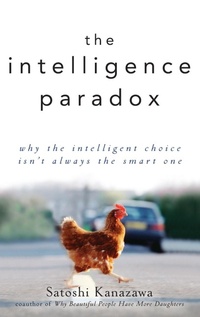
The Intelligence Paradox
Why the Intelligent Choice Isn't Always the Smart One
Published on 19. April 2012
Book
Hardback
272 pages
978-0-470-58695-2 (ISBN)
Description
A book that challenges common misconceptions about the nature of intelligence
Satoshi Kanazawa's Why Beautiful People Have More Daughters (written with Alan S. Miller) was hailed by the Los Angeles Times as "a rollicking bit of pop science that turns the lens of evolutionary psychology on issues of the day." That book answered such burning questions as why women tend to lust after males who already have mates and why newborns look more like Dad than Mom. Now Kanazawa tackles the nature of intelligence: what it is, what it does, what it is good for (if anything). Highly entertaining, smart (dare we say intelligent?), and daringly contrarian, The Intelligence Paradox will provide a deeper understanding of what intelligence is, and what it means for us in our lives.
Challenging common misconceptions about the nature of intelligence, this book offers surprising insights into the cutting-edge of science at the intersection of evolutionary psychology and intelligence research.
More details
Language
English
Place of publication
Chichester
United Kingdom
Publishing group
Turner Publishing Company
Product notice
sewn/stitched
Cloth over boards
Illustrations
Illustrations
Dimensions
Height: 240 mm
Width: 161 mm
Thickness: 19 mm
Weight
570 gr
ISBN-13
978-0-470-58695-2 (9780470586952)
Copyright in bibliographic data and cover images is held by Nielsen Book Services Limited or by the publishers or by their respective licensors: all rights reserved.
Schweitzer Classification
Other editions
Additional editions
E-Book
03/2012
1st Edition
Wiley
€14.49
Available for download
Person
Satoshi Kanazawa was one of the inaugural contributors to the Psychology Today blog and is Associate Editor of the Journal of Social, Evolutionary, and Cultural Psychology. He is a Reader in Management at the London School of Economics and Political Science and Honorary Research Fellow in the Department of Psychology at Birkbeck College, University of London.