

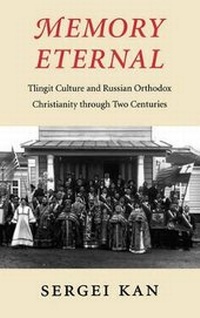
Memory Eternal
Tlingit Culture and Russian Orthodox Christianity Through Two Centuries
Will be published approx. on 1. August 1999
Book
Hardback
696 pages
978-0-295-97806-2 (ISBN)
Description
In Memory Eternal, Sergei Kan combines anthropology and history, anecdote and theory to portray the encounter between the Tlingit Indians and the Russian Orthodox Church in Alaska in the late 1700s and to analyze the indigenous Orthodoxy that developed over the next 200 years. As a native speaker of Russian with eighteen years of fieldwork experience among the Tlingit, Kan is uniquely qualified to relate little-known material from the archives of the Russian church in Alaska to Tlingit oral history and his own observations. By weighing the one body of evidence against the other, he has reevaluated this history, arriving at a persuasive new concept of "converged agendas"-the view that the Tlingit and the Russians tended to act in mutually beneficial ways but for entirely different reasons throughout the period of their contact with one another.
The Russian-American Company began operations in southeastern Alaska in the 1790s. Against a description of Tlingit culture at the time of the Russians' arrival, Kan examines Russian Orthodox theology, ritual practice, and missionary methods, and the Tlingit response to them. An uneasy symbiosis characterized the early era of the Russian-American Company, when the trading relationship outweighed any spiritual or social rapprochement.
A second, major focus of Kan's study is the Tlingit experience with American colonial domination. He attributes a sudden revival of Tlingit interest in Orthodoxy in the 1880s as their attempt to maintain independence in the face of concerted efforts by the newcomers (and especially Presbyterian missionaries) to Americanize them.
Memory Eternal shows the colonial encounter to be both a power struggle and a dialogue between different systems of meaning. It portrays Native Alaskans not as helpless victims but as historical agents who attempted to adjust to the changing reality of their social world without abandoning fundamental principles of their precolonial sociocultural order or their strong sense of self-respect.
The Russian-American Company began operations in southeastern Alaska in the 1790s. Against a description of Tlingit culture at the time of the Russians' arrival, Kan examines Russian Orthodox theology, ritual practice, and missionary methods, and the Tlingit response to them. An uneasy symbiosis characterized the early era of the Russian-American Company, when the trading relationship outweighed any spiritual or social rapprochement.
A second, major focus of Kan's study is the Tlingit experience with American colonial domination. He attributes a sudden revival of Tlingit interest in Orthodoxy in the 1880s as their attempt to maintain independence in the face of concerted efforts by the newcomers (and especially Presbyterian missionaries) to Americanize them.
Memory Eternal shows the colonial encounter to be both a power struggle and a dialogue between different systems of meaning. It portrays Native Alaskans not as helpless victims but as historical agents who attempted to adjust to the changing reality of their social world without abandoning fundamental principles of their precolonial sociocultural order or their strong sense of self-respect.
Reviews / Votes
"This extraordinary book...is a model of historical anthropology."(American Historical Review) "[Provides] a vivid picture of the engagements between the actors who together contributed to transforming Tlingit culture: the different Tlingit families, the Russian traders, Orthodox and Presbyterian missionaries, Russian and U.S. settlers, and Tlingit women and men.
(American Ethnologist)
More details
Series
Language
English
Place of publication
Seattle
United States
Target group
Professional and scholarly
College/higher education
Illustrations
26 illus.
Dimensions
Height: 229 mm
Width: 152 mm
Weight
1116 gr
ISBN-13
978-0-295-97806-2 (9780295978062)
Copyright in bibliographic data and cover images is held by Nielsen Book Services Limited or by the publishers or by their respective licensors: all rights reserved.
Schweitzer Classification
Other editions
Additional editions
E-Book
07/2014
1st Edition
University of Washington Press
€33.99
Available for download
Person
Sergei Kan is professor of anthropology and Native American studies at Dartmouth College.
Content
Preface
Acknowledgments
Introduction
1. Lingit Kusteeyi: Tlingit Economy, Society, and Religion at the Time of Contact
2. Anooshi: The People "from Under the Horizon"
3. The Early Decades of Tlingit-Russian Interaction
4. The Tlingit and the Russian Orthodox Church, 1834-67: From the Smallpox Epidemic to the Sale of Alaska
5. The Early Decades of the Waashdan Kwaan Rule, 1867-85
6. The Massive Conversion to Orthodoxy during the Donskoi Era, 1886-95
7. Native Brotherhoods and the Further Development of Tlingit Orthodoxy, 1895-1917
8. Village Orthodoxy: The Case of Killisnoo
9. Tlingit Orthodoxy as a Cultural System
10. The Difficult Years and the Survival of Tlingit Orthodoxy, 1917-67
11. Tlingit Orthodoxy in a New Era, 1967-90s
12. Conclusion
Notes
Appendix
References
Index
Acknowledgments
Introduction
1. Lingit Kusteeyi: Tlingit Economy, Society, and Religion at the Time of Contact
2. Anooshi: The People "from Under the Horizon"
3. The Early Decades of Tlingit-Russian Interaction
4. The Tlingit and the Russian Orthodox Church, 1834-67: From the Smallpox Epidemic to the Sale of Alaska
5. The Early Decades of the Waashdan Kwaan Rule, 1867-85
6. The Massive Conversion to Orthodoxy during the Donskoi Era, 1886-95
7. Native Brotherhoods and the Further Development of Tlingit Orthodoxy, 1895-1917
8. Village Orthodoxy: The Case of Killisnoo
9. Tlingit Orthodoxy as a Cultural System
10. The Difficult Years and the Survival of Tlingit Orthodoxy, 1917-67
11. Tlingit Orthodoxy in a New Era, 1967-90s
12. Conclusion
Notes
Appendix
References
Index