

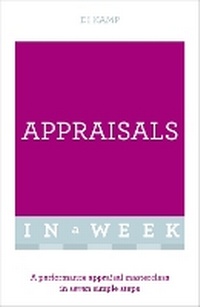
Appraisals In A Week
A Performance Appraisal Masterclass In Seven Simple Steps
Published on 7. January 2016
Book
Paperback/Softback
128 pages
978-1-4736-0852-8 (ISBN)
Description
Effective appraisals just got easier
Appraisals are often seen as an isolated and time-consuming round of paperwork that everyone has to engage in and few see any point to. If we were to truly recognize the potential and intended value of appraisals, they would be regarded completely differently.
The original intention of an appraisal system is to encourage and develop the staff of the organization, so that they all perform to their highest potential. Properly implemented and used, appraisals will help you, if you are a manager, to ensure that your staff are as effective as possible in their work, and thereby to make your area of work a powerful contributing factor to the success of the organization.
Appraisals can also make your job as a manager easier, because they give you the opportunity and framework to encourage and develop your staff. This results in a team of people who feel valued and supported, and who know that their work makes a positive difference to the organization as a whole. As a manager, you can then spend less time and energy on pushing and controlling your team, and more time on the work that moves things forward and is more satisfying.
By the end of the final chapter, you will see how appraisals can make a positive difference to you
as a manager, your staff as individuals, and the organization as a whole.
Sunday: Why appraise?
Monday: Formulating a successful appraisal
Tuesday: The appraiser's role 1: setting the framework
Wednesday: The appraiser's role 2: attitudes and approaches
Thursday: The interview 1: reviewing achievement
Friday: The interview 2: looking ahead
Saturday: Completing the appraisal: after the interview
Appraisals are often seen as an isolated and time-consuming round of paperwork that everyone has to engage in and few see any point to. If we were to truly recognize the potential and intended value of appraisals, they would be regarded completely differently.
The original intention of an appraisal system is to encourage and develop the staff of the organization, so that they all perform to their highest potential. Properly implemented and used, appraisals will help you, if you are a manager, to ensure that your staff are as effective as possible in their work, and thereby to make your area of work a powerful contributing factor to the success of the organization.
Appraisals can also make your job as a manager easier, because they give you the opportunity and framework to encourage and develop your staff. This results in a team of people who feel valued and supported, and who know that their work makes a positive difference to the organization as a whole. As a manager, you can then spend less time and energy on pushing and controlling your team, and more time on the work that moves things forward and is more satisfying.
By the end of the final chapter, you will see how appraisals can make a positive difference to you
as a manager, your staff as individuals, and the organization as a whole.
Sunday: Why appraise?
Monday: Formulating a successful appraisal
Tuesday: The appraiser's role 1: setting the framework
Wednesday: The appraiser's role 2: attitudes and approaches
Thursday: The interview 1: reviewing achievement
Friday: The interview 2: looking ahead
Saturday: Completing the appraisal: after the interview
More details
Language
English
Place of publication
United Kingdom
Publishing group
John Murray Press
Target group
Professional and scholarly
Product notice
Paperback (UK-B)
Dimensions
Height: 198 mm
Width: 137 mm
Thickness: 10 mm
Weight
114 gr
ISBN-13
978-1-4736-0852-8 (9781473608528)
Copyright in bibliographic data and cover images is held by Nielsen Book Services Limited or by the publishers or by their respective licensors: all rights reserved.
Schweitzer Classification
Other editions
Additional editions
E-Book
07/2012
Teach Yourself Books
€3.99
Available for download
Person
Di Kamp is Chief Executive of Meta (UK) Ltd. The company specialises in helping organisations and individuals to develop excellence in management practice. Di has helped a number of organisations to enhance their performance development systems, and has trained both managers and their appraisees in how to use appraisals to enhance performance.
Content
: Sunday: Clarify the real purpose and benefits of doing appraisals, so that you can see why it's worthwhile to give time and energy to them.
: Monday: Learn how to formulate a meaningful and relevant appraisal, which will give the appraisee and the organisation useful information.
: Tuesday: Explore how to set up the appraisal process in a way that makes it easy for you and the appraisee to be well-prepared.
: Wednesday: Look at the attitude and approach you need as an appraiser to elicit the most useful outcomes from the appraisal interview.
: Thursday: Learn how to structure the review part of the appraisal interview to make it meaningful.
: Friday: Learn how to condut the future development part of the appraisal interview in a way that results in achievable actions.
: Saturday: Explore the importance of follow-through after the appraisal interview, to make it part of a whole performance development process, so that it translates into continuous improvement.
: Monday: Learn how to formulate a meaningful and relevant appraisal, which will give the appraisee and the organisation useful information.
: Tuesday: Explore how to set up the appraisal process in a way that makes it easy for you and the appraisee to be well-prepared.
: Wednesday: Look at the attitude and approach you need as an appraiser to elicit the most useful outcomes from the appraisal interview.
: Thursday: Learn how to structure the review part of the appraisal interview to make it meaningful.
: Friday: Learn how to condut the future development part of the appraisal interview in a way that results in achievable actions.
: Saturday: Explore the importance of follow-through after the appraisal interview, to make it part of a whole performance development process, so that it translates into continuous improvement.