

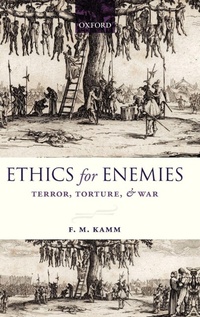
Ethics for Enemies
Terror, Torture, and War
1st Edition
Published on 30. June 2011
Book
Hardback
190 pages
978-0-19-960878-2 (ISBN)
Description
Ethics for Enemies comprises three original philosophical essays on torture, terrorism, and war. F. M. Kamm deploys ethical theory in her challenging new treatments of these most controversial practical issues. First she considers the nature of torture and the various occasions on which it could occur, in order to determine why it might be wrong to torture a wrongdoer held captive, even if this were necessary to save his victims. In the second essay she considers what makes terrorism wrong--whether it is the intention to harm civilians, rather than harm to them being 'collateral damage,' or something else--and whether terrorism is always wrong. The third essay discusses whether having a right reason, in the sense of a right intention, is necessary in order for a war to be just. Kamm then examines ways in which the harms of war can be proportional to the achievement of the just cause and other goods that war can bring about, so as to make the declaration of war permissible.
Reviews / Votes
excellent * Adam Hosein, University of Colorado, Mind Association * This book displays the impressive conceptual sophistication, argumentative rigor and use of imaginary examples characteristic of Kamms philosophical work. It is a valuable addition to the theoretical literature. * Seumas Miller, Notre Dame Philosophical Reviews * closely reasoned and difficult, but powerful, indeed dazzling, display of philosophical imagination. It hardly needs saying that this is an important contribution to applied ethics. It is impossible in a review adequately to summarize and begin to assess the rich detail of these essays. * Joseph Boyle, Ethics * a meticulous, imaginative and often provocative contribution to the ethics of violence ... Kamms analyses of the intricate ethics of the principles of right intention and proportionality in the just war, and of the definitional and moral dimensions of interrogational torture, are no less imaginative and challenging than her reflections on terrorism. Altogether, Ethics for Enemies is a highly important contribution to the literature by a seminal philosopher. * Christopher Finlay, International Affairs *More details
Series
Language
English
Place of publication
Oxford
United Kingdom
Target group
College/higher education
Scholars and students of philosophy, politics, and law; anyone with an interest in the ethics of terrorism, torture, and war.
Dimensions
Height: 240 mm
Width: 161 mm
Thickness: 15 mm
Weight
455 gr
ISBN-13
978-0-19-960878-2 (9780199608782)
Copyright in bibliographic data and cover images is held by Nielsen Book Services Limited or by the publishers or by their respective licensors: all rights reserved.
Schweitzer Classification
Other editions
Additional editions
Book
05/2013
Oxford University Press
€45.40
Shipment within 15-20 days
E-Book
06/2011
1st Edition
OUP eBook
€18.49
Available for download
Person
F.M. Kamm is Littauer Professor of Philosophy and Public Policy, Harvard Kennedy School, and Professor of Philosophy, Harvard University. She is author of Creation and Abortion; Morality, Mortality, Vol 1 and 2; and Intricate Ethics (all from OUP). Kamm has published many articles on normative ethical theory and practical ethics. She has held ACLS, AAUW, NEH, and Guggenheim fellowships and has been a Fellow of the Program in Ethics and the Professions at the Kennedy School, the Center for Human Values at Princeton, and the Center for Advanced Study at Stanford. She is a member of the editorial boards of Philosophy & Public Affairs, Legal Theory, and Utilitas; a member of the steering committee of the Harvard University Program in Ethics and Health; a member of the University Faculty Committee, Safra Center for Ethics; affiliated faculty of Carr Center for Human Rights, and is on the international advisory board of the Uehiro Center for Practical Ethics.
Content
Introduction ; 1. Torture: During and After Action ; 2. Terrorism and Intending Evil ; 3. Reasons for Starting War: Goals, Conditions, and Proportionality ; Bibliography ; Index