


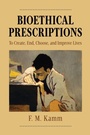
Bioethical Prescriptions
To Create, End, Choose, and Improve Lives
Published on 9. January 2014
Book
Hardback
624 pages
978-0-19-997198-5 (ISBN)
Description
Bioethical Prescriptions collects F.M. Kamm's articles on bioethics, which have appeared over the last twenty-five years and which have made her among the most influential philosophers in this area. Kamm is known for her intricate, sophisticated, and painstaking philosophical analyses of moral problems generally and of bioethical issues in particular. This volume showcases these articles - revised to eliminate redundancies -- as parts of a coherent whole. A substantive introduction identifies important themes than run through the articles. Section headings include Death and Dying; Early Life (on conception and use of embryos, abortion, and childhood); Genetics and Other Enhancements (on cloning and other genetic technologies); Allocating Scarce Resources; and Methodology (on the relation of moral theory and practical ethics).
Reviews / Votes
Frances Kamm is the deepest, most sophisticated, and most fertile thinker in the entire field of bioethics. * Jeff McMahan, Department of Philosophy, Rutgers University * Frances Kamm's newest book, Bioethical Prescriptions, is a treasure trove of careful arguments and penetrating insight. * T.M. Scanlon, Harvard University, Journal of Medical Ethics * ...a must-read for anyone concerned with bioethics...her impressive, monumental work deserves attention. It can be used as a guidebook to bioethical arguments, as well as a textbook and source of numerous moral dilemmas. By following Kamm's argumentation, one can acquaint oneself with rigorous and detailed analytical thinking, which she presents on a masterly level. * Notre Dame Philosophical Reviews * ...it is extremely difficult not to be impressed with her powers of imagination and her moral perceptiveness. Many of the individual chapters brim with crucial insights, decisive counterexamples, and puzzling questions, and together they offer a top-notch deontological exploration into various matters of bioethics as well as into normative ethics in general...I strongly recommend it to students and scholars of bioethics as well as to philosophers interested in normative ethics in general. * Ethics * F.M. Kamm's latest book has something in common with good psychological thrillers: plenty of unexpected twists and turns. They surprise you at first, but in the end you appreciate the author's design...The essays in BP grip the reader more firmly because the discussion is usually anchored in a concrete bioethical issue and each essay stands on its ownYou have to read the book. It is profoundly thought-provoking - as painstakingly careful a work of applied ethics as I have found...I invite readers to discover for themselves the extraordinary twists and turns of Bioethical Prescriptions. * Kennedy Institute of Ethics Journal *More details
Series
Language
English
Place of publication
New York
United States
Target group
College/higher education
Professional and scholarly
Illustrations
13 illus.
Dimensions
Height: 240 mm
Width: 161 mm
Thickness: 40 mm
Weight
1190 gr
ISBN-13
978-0-19-997198-5 (9780199971985)
Copyright in bibliographic data and cover images is held by Nielsen Book Services Limited or by the publishers or by their respective licensors: all rights reserved.
Schweitzer Classification
Other editions
Additional editions
Book
12/2016
Oxford University Press Inc
€49.20
Shipment within 15-20 days
E-Book
11/2013
1st Edition
OUP eBook
€17.49
Available for download
Person
F.M. Kamm is Littauer Professor of Philosophy and Public Policy, Kennedy School of Government, and Professor of Philosophy, Faculty of Arts and Sciences, at Harvard University. She is the author of The Moral Target: Aiming at Right Conduct in War and Other Conflicts (2012), Ethics for Enemies: Terror, Torture, and War (2011), Intricate Ethics: Rights, Responsibilities, and Permissible Harm (2007), Morality, Mortality, Vol. I: Death and Whom to Save from It (1993) and Vol. II: Rights, Duties, and Status (1996), and Creation and Abortion: A Study in Moral and Legal Philosophy (1992), all from Oxford University Press.
Content
Introduction ; Acknowledgments ; Part I Death and Dying ; Chapter 1 Rescuing Ivan Ilych: How We Live and How We Die ; Chapter 2 Conceptual Issues Related to Ending Life ; Chapter 3 Problems with <"Assisted Suicide: The Philosophers' Brief>" ; Chapter 4 Four-Step Arguments for Physician-Assisted Suicide and Euthanasia ; Chapter 5 Some Arguments by Velleman Concerning Suicide and Assisted Suicide ; Chapter 6 Brody on Active and Passive Euthanasia ; Chapter 7 A Note on Dementia and Advance Directives ; Chapter 8 Brain Death and Spontaneous Breathing ; Part II Young Life ; Chapter 9 Using Human Embryos for Biomedical Research ; Chapter 10 Ethical Issues in Using and Not Using Human Embryonic Stem Cells ; Chapter 1 Ronald Dworkin's Views on Abortion ; Chapter 12 Creation and Abortion Short ; Chapter 13 McMahan on the Ethics of Killing at the Margins of Life ; Chapter 14 Some Conceptual and Ethical Issues in Munchausen Syndrome by Proxy ; Part III Genetic and Other Enhancements ; Chapter 15 Genes, Justice, and Obligations to Future People ; Chapter 16 Moral Status, Personal Identity, and Substitutability: Clones, Embryos, and Future Generations ; Chapter 17 What Is and Is Not Wrong with Enhancement ; Part IV Allocating Scarce Resources ; Chapter 18 Health and Equity ; Chapter 19 Health and Equality of Opportunity ; Chapter 20 Is it Morally Permissible to Discontinue NonFutile Use of a Scarce Resource? ; Chapter 21 Aggregation, Allocating Scarce Resources, and Discrimination Against the Disabled ; Chapter 22 Rationing and the Disabled: Several Proposals ; Chapter 23 Learning from Bioethics: Moral Issues in Rationing Non-Medical Scarce Resources ; Part V Methodology ; Chapter 24 The Philosopher as Insider and Outsider ; Chapter 25 Theory and Analogy ; Chapter 26 Relations between High Theory, Low Theory, and Applying Applied Ethics ; Chapter 27 Understanding, Justifying, and Finding Oneself ; Index