

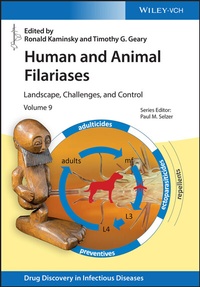
Human and Animal Filariases
Landscape, Challenges, and Control
1st Edition
Published on 14. December 2022
Book
Hardback
656 pages
978-3-527-34659-2 (ISBN)
Description
The holistic view on combating filarial parasites in humans and in animals covers diagnosis, current and future therapies, as well as supplementary approaches such as vector control and vaccination.
More details
Series
Edition
1. Auflage
Language
English
Place of publication
Berlin
Germany
Target group
Professional and scholarly
Illustrations
58
150 s/w Abbildungen, 100 farbige Abbildungen
Dimensions
Height: 24.4 cm
Width: 17 cm
Thickness: 3.6 cm
Weight
1188 gr
ISBN-13
978-3-527-34659-2 (9783527346592)
Schweitzer Classification
Other editions
Additional editions
E-Book
10/2022
1st Edition
Wiley-VCH
€165.99
Available for download
E-Book
10/2022
1st Edition
Wiley-VCH
€165.99
Available for download
Persons
Ronald Kaminsky is a widely-recognized expert in the discovery and development of antiparasitic drugs with an extensive history of research on trypanosomiasis in Africa and Switzerland. He served as Head of Parasitology Research at Novartis Animal Health from 2006-2014 and is currently a consultant for antiparasitic drug discovery in the animal health sector. Dr. Kaminsky has authored more than 100 publications and received numerous awards during his career in academia and industry.
Timothy Geary is the former Director of the Institute of Parasitology at McGill University. Prior to joining the faculty at McGill in 2005, he spent 20 years in parasitology research in the animal health industry (Upjohn/Pharmacia/Pfizer). The author of more than 225 publications in the pharmacology of antiparasitic drugs and drug discovery and development, Prof. Geary serves as a consultant to many animal health companies and other organizations.
Paul M. Selzer studied Biology, Parasitology, and Biochemistry at the University of Tübingen, Germany, where he also received his PhD in Biochemistry. During his career he has worked as a researcher and scientific manager for several pharmaceutical companies, and is currently holding a management position in antiparasitic drug discovery at Boehringer Ingelheim Animal Health. He is also a visiting professor at the Interfaculty Institute of Biochemistry of the University of Tübingen, DE and an honorary professor of the Department of Infection, Immunity, and Inflammation at the University of Glasgow, UK.
Timothy Geary is the former Director of the Institute of Parasitology at McGill University. Prior to joining the faculty at McGill in 2005, he spent 20 years in parasitology research in the animal health industry (Upjohn/Pharmacia/Pfizer). The author of more than 225 publications in the pharmacology of antiparasitic drugs and drug discovery and development, Prof. Geary serves as a consultant to many animal health companies and other organizations.
Paul M. Selzer studied Biology, Parasitology, and Biochemistry at the University of Tübingen, Germany, where he also received his PhD in Biochemistry. During his career he has worked as a researcher and scientific manager for several pharmaceutical companies, and is currently holding a management position in antiparasitic drug discovery at Boehringer Ingelheim Animal Health. He is also a visiting professor at the Interfaculty Institute of Biochemistry of the University of Tübingen, DE and an honorary professor of the Department of Infection, Immunity, and Inflammation at the University of Glasgow, UK.
Content
Introduction
Filariae as Organisms
Human Filarial Infections: Reflections on the Current Understanding of Their Importance, Pathobiology and Management
Canine Filariasis (Heartworm) - Disease and Current Gaps
Veterinary Diagnosis of Filarial Infection
Antifilarial Chemotherapy: Current Options for Humans
Antifilarial Chemotherapy: Current Options in Veterinary Medicine
Heartworm Disease - Intervention and Industry Perspective
Current Antifilarial Drugs - Mechanisms of Action
Drug Resistance in Filariae
Elimination and Eradication of Human Filariases
Global Economics of Heartworm Disease
Product Profiles for New Drugs Against Human and Animal Filariasis
Discovery and Development of New Antifilarial Drugs (in vitro Assays)
In vivo Models for the Discovery of New Antifilarial Drugs
In vivo Assays - Discovery and Development of New Antifilarial Drugs in Companion Animals
The Antifilarial Drug Pipeline
The Host-Helminth Interface as a Rich Resource for Novel Drug Targets
Functional Genomics of Filariae
Development of a Vaccine Against Onchocerca volvulus
Vector Control Approaches to Interrupt Transmission of Human Filarial Parasites
Vector Control Approaches for Canine Filariasis
Wolbachia Endosymbionts as Treatment Targets for Filarial Diseases
Filariae as Organisms
Human Filarial Infections: Reflections on the Current Understanding of Their Importance, Pathobiology and Management
Canine Filariasis (Heartworm) - Disease and Current Gaps
Veterinary Diagnosis of Filarial Infection
Antifilarial Chemotherapy: Current Options for Humans
Antifilarial Chemotherapy: Current Options in Veterinary Medicine
Heartworm Disease - Intervention and Industry Perspective
Current Antifilarial Drugs - Mechanisms of Action
Drug Resistance in Filariae
Elimination and Eradication of Human Filariases
Global Economics of Heartworm Disease
Product Profiles for New Drugs Against Human and Animal Filariasis
Discovery and Development of New Antifilarial Drugs (in vitro Assays)
In vivo Models for the Discovery of New Antifilarial Drugs
In vivo Assays - Discovery and Development of New Antifilarial Drugs in Companion Animals
The Antifilarial Drug Pipeline
The Host-Helminth Interface as a Rich Resource for Novel Drug Targets
Functional Genomics of Filariae
Development of a Vaccine Against Onchocerca volvulus
Vector Control Approaches to Interrupt Transmission of Human Filarial Parasites
Vector Control Approaches for Canine Filariasis
Wolbachia Endosymbionts as Treatment Targets for Filarial Diseases