

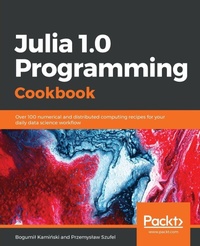
Julia 1.0 Programming Cookbook
Over 100 numerical and distributed computing recipes for your daily data science work?ow
Published on 29. November 2018
Book
Paperback/Softback
460 pages
978-1-78899-836-9 (ISBN)
Description
Discover the new features and widely used packages in Julia to solve complex computational problems in your statistical applications.
Key Features
Address the core problems of programming in Julia with the most popular packages for common tasks
Tackle issues while working with Databases and Parallel data processing with Julia
Explore advanced features such as metaprogramming, functional programming, and user defined types
Book DescriptionJulia, with its dynamic nature and high-performance, provides comparatively minimal time for the development of computational models with easy-to-maintain computational code. This book will be your solution-based guide as it will take you through different programming aspects with Julia.
Starting with the new features of Julia 1.0, each recipe addresses a specific problem, providing a solution and explaining how it works. You will work with the powerful Julia tools and data structures along with the most popular Julia packages. You will learn to create vectors, handle variables, and work with functions. You will be introduced to various recipes for numerical computing, distributed computing, and achieving high performance. You will see how to optimize data science programs with parallel computing and memory allocation. We will look into more advanced concepts such as metaprogramming and functional programming. Finally, you will learn how to tackle issues while working with databases and data processing, and will learn about on data science problems, data modeling, data analysis, data manipulation, parallel processing, and cloud computing with Julia.
By the end of the book, you will have acquired the skills to work more effectively with your data
What you will learn
Boost your code's performance using Julia's unique features
Organize data in to fundamental types of collections: arrays and dictionaries
Organize data science processes within Julia and solve related problems
Scale Julia computations with cloud computing
Write data to IO streams with Julia and handle web transfer
Define your own immutable and mutable types
Speed up the development process using metaprogramming
Who this book is forThe target audience of this book is data scientists or programmers that want to improve their skills in working with the Julia programming language. It is recommended that the user has a little experience with Julia or intermediate-level experience with other programming languages such as Python, R, or MATLAB.
Key Features
Address the core problems of programming in Julia with the most popular packages for common tasks
Tackle issues while working with Databases and Parallel data processing with Julia
Explore advanced features such as metaprogramming, functional programming, and user defined types
Book DescriptionJulia, with its dynamic nature and high-performance, provides comparatively minimal time for the development of computational models with easy-to-maintain computational code. This book will be your solution-based guide as it will take you through different programming aspects with Julia.
Starting with the new features of Julia 1.0, each recipe addresses a specific problem, providing a solution and explaining how it works. You will work with the powerful Julia tools and data structures along with the most popular Julia packages. You will learn to create vectors, handle variables, and work with functions. You will be introduced to various recipes for numerical computing, distributed computing, and achieving high performance. You will see how to optimize data science programs with parallel computing and memory allocation. We will look into more advanced concepts such as metaprogramming and functional programming. Finally, you will learn how to tackle issues while working with databases and data processing, and will learn about on data science problems, data modeling, data analysis, data manipulation, parallel processing, and cloud computing with Julia.
By the end of the book, you will have acquired the skills to work more effectively with your data
What you will learn
Boost your code's performance using Julia's unique features
Organize data in to fundamental types of collections: arrays and dictionaries
Organize data science processes within Julia and solve related problems
Scale Julia computations with cloud computing
Write data to IO streams with Julia and handle web transfer
Define your own immutable and mutable types
Speed up the development process using metaprogramming
Who this book is forThe target audience of this book is data scientists or programmers that want to improve their skills in working with the Julia programming language. It is recommended that the user has a little experience with Julia or intermediate-level experience with other programming languages such as Python, R, or MATLAB.
More details
Language
English
Place of publication
Birmingham
United Kingdom
Target group
Professional and scholarly
US School Grade: College Graduate Student
Dimensions
Height: 235 mm
Width: 191 mm
Thickness: 25 mm
Weight
852 gr
ISBN-13
978-1-78899-836-9 (9781788998369)
Copyright in bibliographic data and cover images is held by Nielsen Book Services Limited or by the publishers or by their respective licensors: all rights reserved.
Schweitzer Classification
Other editions
Additional editions
Bogumil Kaminski | Przemyslaw Szufel
Julia 1.0 Programming Cookbook
Over 100 numerical and distributed computing recipes for your daily data science workflow
E-Book
09/2024
Packt Publishing
€34.99
Available for download
Persons
Bogumi Kamiski (GitHub username: bkamins) is an associate professor and head of the Decision Support and Analysis Unit at the SGH Warsaw School of Economics, as well as adjunct professor at the data science laboratory, Ryerson University, Toronto. He is coeditor of the Central European Journal of Economic Modeling and Econometrics, and of the Multiple Criteria Decision Making journal. His scientific interests center on operational research and computational social science. He has authored over 50 research articles on simulation, optimization, and prediction methods. He also has 15+ years' experience in the deployment of large-scale advanced analytics solutions for industry and public administration. Przemysaw Szufel (GitHub username: pszufe) is an assistant professor in the Decision Support and Analysis Unit at the SGH Warsaw School of Economics. His current research focuses on distributed systems and methods for the execution of large-scale simulations for numerical experiments and optimization. He is working on asynchronous algorithms for the parallel execution of large-scale computations in the cloud and distributed computational environments. He has authored, and co-authored, several open source tools for high-performance and numerical simulation.
Content
Table of Contents
Installing and Setting up Julia
Data Structures and Algorithms
Data Engineering in Julia
Numerical Computing with Julia
Variables, types and functions
Metaprogramming and advanced typing
Handling analytical data
Julia Workflow
Data Science
Distributed Computing
Installing and Setting up Julia
Data Structures and Algorithms
Data Engineering in Julia
Numerical Computing with Julia
Variables, types and functions
Metaprogramming and advanced typing
Handling analytical data
Julia Workflow
Data Science
Distributed Computing