

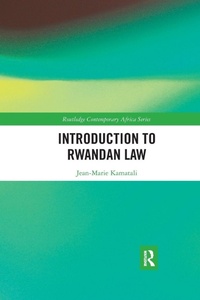
Introduction to Rwandan Law
1st Edition
Published on 30. September 2021
Book
Paperback/Softback
244 pages
978-1-032-17574-4 (ISBN)
Description
This book explores key innovations in Rwandan law, exploring how the country has tried to combine the homegrown legal system with the civil law and common law legal systems to create a new hybrid legal system.
The author explores the history of Rwandan law through the pre-colonial, to colonial and post-independence periods, and examines the homegrown legal and justice approaches, such as Gacaca, Abunzi, and Imihigo, introduced to deal with legal problems that could not be dealt with using the western legal system in post genocide Rwanda. The book highlights the innovative Rwandan approach to incorporating international law in the domestic legal system; it also covers the evolution of Rwandan constitutional law and constitutionalism since independence, and the development of family law from a legal system that oppressed women to one that promotes the rights of girls and women. Finally, the book explores the combination of common law and civil law systems in the development of the new Rwandan criminal law and in the transformation of the organization, jurisdiction, and functioning of Rwandan courts.
This book will be of interest to scholars and students of African law, international law, and the legal system in Rwanda.
The author explores the history of Rwandan law through the pre-colonial, to colonial and post-independence periods, and examines the homegrown legal and justice approaches, such as Gacaca, Abunzi, and Imihigo, introduced to deal with legal problems that could not be dealt with using the western legal system in post genocide Rwanda. The book highlights the innovative Rwandan approach to incorporating international law in the domestic legal system; it also covers the evolution of Rwandan constitutional law and constitutionalism since independence, and the development of family law from a legal system that oppressed women to one that promotes the rights of girls and women. Finally, the book explores the combination of common law and civil law systems in the development of the new Rwandan criminal law and in the transformation of the organization, jurisdiction, and functioning of Rwandan courts.
This book will be of interest to scholars and students of African law, international law, and the legal system in Rwanda.
More details
Series
Language
English
Place of publication
London
United Kingdom
Publishing group
Taylor & Francis Ltd
Target group
College/higher education
Postgraduate and Undergraduate
Illustrations
1 s/w Abbildung
1 Illustrations, black and white
Dimensions
Height: 234 mm
Width: 156 mm
Thickness: 13 mm
Weight
380 gr
ISBN-13
978-1-032-17574-4 (9781032175744)
Copyright in bibliographic data and cover images is held by Nielsen Book Services Limited or by the publishers or by their respective licensors: all rights reserved.
Schweitzer Classification
Other editions
Additional editions
Jean-Marie Kamatali
Introduction to Rwandan Law
Book
01/2020
1st Edition
Routledge
€179.51
Shipment within 15-20 days
Jean-Marie Kamatali
Introduction to Rwandan Law
E-Book
01/2020
1st Edition
Routledge
€59.49
Available for download
Jean-Marie Kamatali
Introduction to Rwandan Law
E-Book
01/2020
1st Edition
Routledge
€59.49
Available for download
Person
Jean-Marie Kamatali is a tenured professor of law and director of the Center for Democratic Governance and Rule of Law at Ohio Northern University Law School. Between 1998-2002, Professor Kamatali served as Dean and Professor at the National University of Rwanda, the only law school in Rwanda.
Content
1. History of Rwandan Law 2. Homegrown Legal Concepts and Solutions: Gacaca, Abunzi and Imihigo 3. Rwandan Constitutional Law 4. Rwandan International Law 5. Organization, Jurisdiction, and Functioning of Rwanda's Judiciary 6. Persons, Family, Matrimonial Regimes, and Succession 7. Criminal Law