

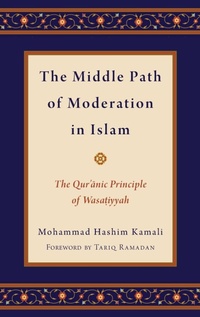
The Middle Path of Moderation in Islam
The Qur'anic Principle of Wasatiyyah
Published on 9. July 2015
Book
Hardback
336 pages
978-0-19-022683-1 (ISBN)
Description
In The Middle Path of Moderation in Islam, leading Islamic law expert Mohammad Hashim Kamali examines the concept of wasatiyyah, or moderation, arguing that scholars, religious communities, and policy circles alike must have access to this governing principle that drives the silent majority of Muslims, rather than focusing on the extremist fringe. Kamali explores wasatiyyah in both historical/conceptual terms and in contemporary/practical terms. Tracing the definition and scope of the concept from the foundational sources of Islam, the Qu'ran and Hadith, he demonstrates that wasatiyyah has a long and well-developed history in Islamic law and applies the concept to contemporary issues of global policy, such as justice, women's rights, environmental and financial balance, and globalization. Framing his work as an open dialogue against a now-decades long formulation of the arguably destructive Huntingtonian "clash of civilizations" thesis as well as the public rhetoric of fear of Muslim extremism since the attacks of Sept. 11, 2001, Kamali connects historical conceptions of wasatiyyah to the themes of state and international law, governance, and cultural maladies in the Muslim world and beyond. Both a descriptive and prescriptive meditation on a key but often neglected principle of Islam, The Middle Path of Moderation in Islam provides insight into an idea that is in the strategic interest of the West both to show and practice for themselves and to recognize in Muslim countries.
Reviews / Votes
invaluable ... Kamali makes a crucial set of observations about how moderate Islamic traditions go beyond just dealing tolerantly with other religions ... A culmination of his decades of scholarship on Islamic law and jurisprudence, this book should serve as an important reference for years to come. * I. Blumi, CHOICE * This scholarly book is a major addition to works that deal with 'moderate' Islam, still the Islam of the majority of Muslims, which is also traditional Islam. Drawing from a wide range of sources and many notable voices, Kamali presents an extensive range of issues from social justice to the environmental crisis, from spirituality to relation with other religions, all seen from the perspective of moderation or wasaIiyyah, which is the authentic Islamic perspective. Kamali is to be congratulated for writing a much needed work on normative and genuine Islam at a time when so many strident forces and voices, both the non-Islamic and nominally Islamic, are seeking to eclipse in the eyes of many the authentic image of the Islamic religion. * Seyyed Hossein Nasr, University Professor of Islamic Studies, The George Washington University * an essential addition to the body of knowledge after more than forty years of uninterrupted contribution to the study of Islamic studies. * Alhagi Manta Drammeh, The Islamic Quarterly *More details
Series
Language
English
Place of publication
New York
United States
Target group
College/higher education
Professional and scholarly
Dimensions
Height: 240 mm
Width: 161 mm
Thickness: 24 mm
Weight
731 gr
ISBN-13
978-0-19-022683-1 (9780190226831)
Copyright in bibliographic data and cover images is held by Nielsen Book Services Limited or by the publishers or by their respective licensors: all rights reserved.
Schweitzer Classification
Other editions
Additional editions
E-Book
05/2015
1st Edition
OUP eBook
€22.99
Available for download
Mohammad Hashim Kamali
Middle Path of Moderation in Islam: The Qur'anic Principle of Wasatiyyah
The Qur'anic Principle of Wasatiyyah
E-Book
01/2015
1st Edition
Oxford University Press, USA
€28.49
Available for download
Persons
Mohammad Hashim Kamali was Dean and Professor at the International Institute of Islamic Thought and Civilization (ISTAC) and the International Islamic University in Malaysia. He currently heads the International Institute of Advanced Islamic Studies (IAIS) Malaysia.
Tariq Ramadan is Professor of Contemporary Islamic Studies at Oxford University (Oriental Institute, St. Antony's College).
Tariq Ramadan is Professor of Contemporary Islamic Studies at Oxford University (Oriental Institute, St. Antony's College).
Content
Foreword ; I. Introduction ; Part One: Conceptual Analysis ; II. Definition and Scope of Wasatiyyah ; III. Review of the Source Evidence ; IV. A Round-up of Modern Opinion ; V. Hallmarks of Extremism ; VI. Manifestations of Wasatiyyah ; VII. Identification of Wasatiyyah ; VIII. Institutional Developments ; Part Two: Thematic Perspectives ; IX. Moderation and Justice ; X. Moderation in Religiosity ; XI. The Moderating Role of Ikhtilaf (Reasoned Disagreement) ; XII. Between Spirituality and Legalism: The Moderating Influence of Sufism ; XIII. Harm (Darar) Must Be Eliminated ; XIV. Forbearance, Bringing Ease and Removing Hardship ; XV. Environmental Imbalance ; XVI. Financial Imbalance, Extravagance and Waste ; XVII. Moderation in Jihad ; XVIII. Character and Lifestyle ; XIX. Wasatiyyah and Women's Rights ; XX. Wasatiyyah and Globalisation ; XXI. Islam between Antiquity and the Modern World ; XXII. Continuity and Change: An Analysis of Tajdid and Islah (Renewal and Reform) in Islam ; XXIII. Conclusion and Recommendations ; Glossary ; Bibliography ; Index of Qur'anic Verses and Hadith ; General Index