

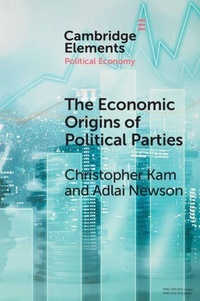
The Economic Origin of Political Parties
Published on 7. January 2021
Book
Paperback/Softback
98 pages
978-1-108-82842-0 (ISBN)
Description
This Element examines how the changing economic basis of parliamentary elections in nineteenth century England and Wales contributed to the development of modern parties and elections. Even after the 1832 Reform Act expanded the British electorate, elections in many constituencies went uncontested, party labels were nominal, and candidates spent large sums treating and bribing voters. By the end of the century, however, almost every constituency was contested, candidates stood as representatives of national parties, and campaigns were fought on the basis of policies. We show how industrialization, the spread of literacy, and the rise of cheap newspapers, encouraged candidates to enter and contest constituencies. The increased expense that came from fighting frequent elections in larger constituencies induced co-partisan candidates to form slates. This imparted a uniform partisan character to parliamentary elections that facilitated the emergence of programmatic political parties.
More details
Series
Language
English
Place of publication
Cambridge
United Kingdom
Target group
Professional and scholarly
Product notice
Paperback (trade)
Illustrations
Worked examples or Exercises
Dimensions
Height: 229 mm
Width: 152 mm
Thickness: 5 mm
Weight
141 gr
ISBN-13
978-1-108-82842-0 (9781108828420)
Copyright in bibliographic data and cover images is held by Nielsen Book Services Limited or by the publishers or by their respective licensors: all rights reserved.
Schweitzer Classification
Other editions
Additional editions
Christopher Kam | Adlai Newson
The Economic Origin of Political Parties
E-Book
01/2021
Cambridge University Press
€15.49
Available for download
Christopher Kam
Economic Origin of Political Parties
E-Book
01/2021
Cambridge University Press
€14.49
Available for download
Content
1. Introduction; 2. The Onset of electoral contestation; 3. The economics of elections; 4. Slate formation; 5. Conclusion.