

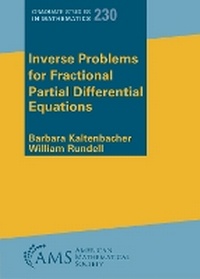
Inverse Problems for Fractional Partial Differential Equations
Published on 15. August 2023
Book
Paperback/Softback
978-1-4704-7277-1 (ISBN)
Description
As the title of the book indicates, this is primarily a book on partial differential equations (PDEs) with two definite slants: toward inverse problems and to the inclusion of fractional derivatives. The standard paradigm, or direct problem, is to take a PDE, including all coefficients and initial/boundary conditions, and to determine the solution. The inverse problem reverses this approach asking what information about coefficients of the model can be obtained from partial information on the solution. Answering this question requires knowledge of the underlying physical model, including the exact dependence on material parameters.
The last feature of the approach taken by the authors is the inclusion of fractional derivatives. This is driven by direct physical applications: a fractional derivative model often allows greater adherence to physical observations than the traditional integer order case.
The book also has an extensive historical section and the material that can be called ""fractional calculus"" and ordinary differential equations with fractional derivatives. This part is accessible to advanced undergraduates with basic knowledge on real and complex analysis. At the other end of the spectrum, lie nonlinear fractional PDEs that require a standard graduate level course on PDEs.
The last feature of the approach taken by the authors is the inclusion of fractional derivatives. This is driven by direct physical applications: a fractional derivative model often allows greater adherence to physical observations than the traditional integer order case.
The book also has an extensive historical section and the material that can be called ""fractional calculus"" and ordinary differential equations with fractional derivatives. This part is accessible to advanced undergraduates with basic knowledge on real and complex analysis. At the other end of the spectrum, lie nonlinear fractional PDEs that require a standard graduate level course on PDEs.
More details
Series
Language
English
Place of publication
Providence
United States
Target group
Professional and scholarly
Weight
413 gr
ISBN-13
978-1-4704-7277-1 (9781470472771)
Copyright in bibliographic data and cover images is held by Nielsen Book Services Limited or by the publishers or by their respective licensors: all rights reserved.
Schweitzer Classification
Persons
Barbara Kaltenbacher, University of Klagfurt, Klagenfurt, Austria.
William Rundell, Texas A&M University, College Station, TX.
William Rundell, Texas A&M University, College Station, TX.
Content
Preamble
Genesis of fractional models
Special functions and tools
Fractional calculus
Fractional ordinary differential equations
Mathematical theory of subdiffusion
Analysis of fractionally damped wave equations
Methods for solving inverse problems
Fundamental inverse problems for fractional order models
Inverse problems for fractional diffusion
Inverse problems for fractionally damped wave equations
Outlook beyond Abel
Mathematical preliminaries
Bibliography
Index
Genesis of fractional models
Special functions and tools
Fractional calculus
Fractional ordinary differential equations
Mathematical theory of subdiffusion
Analysis of fractionally damped wave equations
Methods for solving inverse problems
Fundamental inverse problems for fractional order models
Inverse problems for fractional diffusion
Inverse problems for fractionally damped wave equations
Outlook beyond Abel
Mathematical preliminaries
Bibliography
Index