

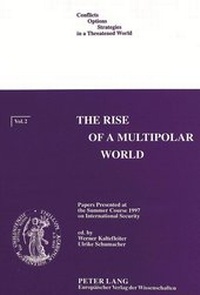
The Rise of a Multipolar World
Papers presented at the Summer Course 1997 on International Security
Published on 1. April 1998
Book
Paperback/Softback
214 pages
978-3-631-33286-3 (ISBN)
Description
The international system which was characterized by its bipolar structure until the end of the systemic conflict undergoes a process of change. New regional power centres seem to emerge in various parts of the world. Those centres have begun to position themselves in different roles in their regions. China seems to be on its way towards a position as hegemon in the Asia-Pacific region. India is trying to determine its foreign policy under new auspices after the end of the concept of non-aligned states. Brazil seems to be using its geostrategic position to dominate the South American continent. Those are some examples of the change in the international system from bipolarity to multipolarity. In order to restructure the international community, several approaches can be discussed. Will the United States of America be the world's only superpower? Or, will the United Nations be able to provide collective security? The lectures presented at the Summer Course on International Security 1997 attempt to at least partially answer these questions.
More details
Persons
The Editors: Werner Kaltefleiter held the Chair of Political Science at the University of Kiel and was Director both of the Institute of Political Science and the Institute of Security Studies.
Ulrike Schumacher holds tenured position as Academic Director at the same University and is Deputy Director of the Institute of Security Studies.
Ulrike Schumacher holds tenured position as Academic Director at the same University and is Deputy Director of the Institute of Security Studies.
Content
Contents: Manfred R.F. Gerber: Keynote speech: The Role of Multinational Forces - Robert L. Pfaltzgraff: The United States: The World's Only Superpower - Gerald Segal: How Insecure is Pacific Asia? - Subrata Mitra: India and the South Asian Security Dilemma - Gilberto Calcagnotto: The Function of Brazil as a Regional Power - Colin Gray: Deterrence and Regional Conflicts: Hopes, Fallacies and «Fixes» - William R. Van Cleave: The Function of Missile Defense - Edward Keynes: Civil-Military Relations in Liberal Democracies - Justin Morris: Collective Security, the United Nations and the Challenge of the Future.