

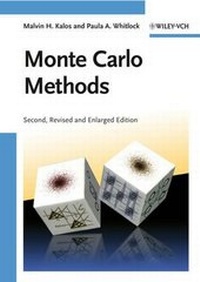
Monte Carlo Methods
2nd Edition
Published on 17. September 2008
Book
Hardback
XII, 203 pages
978-3-527-40760-6 (ISBN)
Description
This introduction to Monte Carlo methods seeks to identify and study the unifying elements that underlie their effective application. Initial chapters provide a short treatment of the probability and statistics needed as background, enabling those without experience in Monte Carlo techniques to apply these ideas to their research.
The book focuses on two basic themes: The first is the importance of random walks as they occur both in natural stochastic systems and in their relationship to integral and differential equations. The second theme is that of variance reduction in general and importance sampling in particular as a technique for efficient use of the methods. Random walks are introduced with an elementary example in which the modeling of radiation transport arises directly from a schematic probabilistic description of the interaction of radiation with matter. Building on this example, the relationship between random walks and integral equations is outlined. The applicability of these ideas to other problems is shown by a clear and elementary introduction to the solution of the Schrödinger equation by random walks.
The text includes sample problems that readers can solve by themselves to illustrate the content of each chapter.
This is the second, completely revised and extended edition of the successful monograph, which brings the treatment up to date and incorporates the many advances in Monte Carlo techniques and their applications, while retaining the original elementary but general approach.
Reviews / Votes
"Engineers with a strong mathematical background who are interested in learning about the technical details of Monte Carlo methods and applying these methods would benefit from this book." (IEEE Electrical Insulation Magazine, 2009)More details
Edition
2. überarb. u. erw. Auflage
Language
English
Place of publication
Berlin
Germany
Target group
Professional and scholarly
Edition type
New edition
Illustrations
64
56 s/w Abbildungen, 8 s/w Tabellen
Dimensions
Height: 24 cm
Width: 17 cm
Thickness: 2 cm
Weight
506 gr
ISBN-13
978-3-527-40760-6 (9783527407606)
Schweitzer Classification
Other editions
Additional editions
Malvin H. Kalos | Paula A. Whitlock
Monte Carlo Methods
E-Book
06/2009
2nd Edition
Wiley-VCH
€142.99
Available for download
Previous edition

Malvin H. Kalos | Paula A. Whitlock
Monte Carlo Methods
Book
10/1986
1st Edition
Wiley
€125.00
Article exhausted; check for reprint
Persons
Malvin H. Kalos is a physicist at the Lawrence Livermore National Laboratory. He received his PhD in Physics at the University of Illinois in 1952. After postdoctoral research at Illinois and Cornell, he joined the staff of the United Nuclear Corporation. In 1964, he became a Senior Research Scientist, later Research Professor and then Professor of Computer Science at the Courant Institute of Mathematical Sciences, New York University. In 1989, he returned to Cornell as Professor of Physics and Director of the Theory Center. His research interests include Monte Carlo Methods and computational many-body physics. Professor Kalos is the recipient of the 1989 Feenberg Memorial Medal for advancement of many-body theories from first principles.
Paula A. Whitlock is Professor of Computer and Information Sciences at Brooklyn College, the City University of New York. She received her BS at the State University of New York at Stony Brook and her PhD at Wayne State University. For many years, she was a research scientistat the Courant Institute of Mathematical Sciences, New York University. Her research interests include the development of Monte Carlo methods and their application to the study of condensed matter systems. Professor Whitlock is also interested in the development of applications in distributed computing.
Content
Preface
1 What is Monte Carlo?
2 A Bit of Probability
3 Sampling Random Variables
4 Monte Carlo Evaluation of Finite-Dimensional Integrals
5 Random Walks, Integral Equations, and Variance Reduction
6 Simulations of Stochastic Systems: Radiation Transport
7 Statistical Physics
8 Quantum Monte Carlo
9 Pseudorandom Numbers