

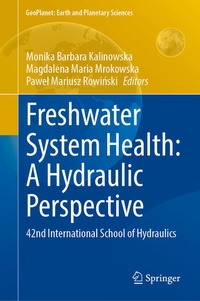
Freshwater System Health: A Hydraulic Perspective
Description
This book offers a comprehensive overview of recent advances in environmental hydraulics, encompassing experimental research, numerical modelling, and theoretical developments. Framed by the pressing global water challenges - Too Much, Too Little, Too Polluted - the contributions emphasise the pivotal role of hydraulics in understanding and safeguarding the health of rivers, lakes, and other aquatic ecosystems. Drawing on the latest insights into natural aquatic processes and practical solutions for civil engineering and water resources management, the volume highlights the importance of interdisciplinary collaboration among ecologists, biologists, and hydraulic engineers. These cooperative efforts are essential for mitigating the impacts of anthropogenic pressures on river habitats.
The book features peer-reviewed versions of invited lectures and regular presentations from the 42nd International School of Hydraulics, held May 20-23, 2025, in Radocza, Poland. With contributions from leading experts and emerging researchers alike, it spans a broad spectrum of topics in environmental hydraulics, including sediment and pollutant transport, fluvial morphodynamics, hydraulic structures in rivers and reservoirs, and innovative measures for freshwater fish protection.
More details
Persons
Monika Kalinowska is an Associate Professor at the Institute of Geophysics, Polish Academy of Sciences and Head of the PhD Studies. Her main research interests include modelling the spread of pollutants in surface-flowing waters and numerical methods in fluid mechanics. She is a member of the Committee on Water Sciences and Water Management of the Polish Academy of Sciences, and the International Association of Water and Environmental Engineering and Research.
Magdalena Mrokowska is an Associate Professor and Head of the Hydrodynamic Models Laboratory at the Institute of Geophysics, Polish Academy of Sciences. Her laboratory research integrates fluid mechanics and chemistry to investigate particle transport in marine and riverine environments, with a focus on stratified aquatic systems, biologically modified water rheology, particularly emphasising the transport of microplastics.
Pawel Rowinski is a professor of Earth sciences at the Institute of Geophysics, Polish Academy of Sciences and its Director. His research interests include environmental hydrodynamics, mathematical modelling and experimental studies of hydrological processes. He is the Chair of the Europe Division of the International Association for Hydro-Environment Engineering and Research IAHR. He also chairs the Committee on Water Sciences and Water Management of the Polish Academy of Sciences. He served as Vice-President of the Polish Academy of Sciences from 2015 to 2022 and is currently the President of the European Federation of Academies of Sciences and Humanities, ALLEA.
Content
Chapter 1. An experimental setup for thermal jet dispersion analysis.- Chapter 2. Estimation of sediment yields under climate change and land-use impact in the upper catchment of the Tuul River Basin, Mongolia.- Chapter 3. From the Renaissance to turbulence - a modern look at da Vinci's impinging jet flow.- Chapter 4. Method for Measuring High Tracer Concentrations in River Mixing Studies.- Chapter 5. Flow resistance due to stream meandering: an evaluation of existing methods and implications for streamflow estimation.- Chapter 6. Critical Submergence for Horizontal Intake Structures under Symmetrical Approach Flow Conditions.- Chapter 7. Analysis of the 2024 flood events in the upper Biala Ladecka basin up to the town of Ladek-Zdrój.- Chapter 8. An experimental study on downstream fish guidance efficiency.- Chapter 9. Towards Sustainability in Water Distribution Networks.- Chapter 10. Sedimentation conditions in small anthropogenic pond estimated by fast field measurements with the use of unmanned vehicles.- Chapter 11. Are we getting dry? A satellite-based analysis of water conditions in the Vistula River.