

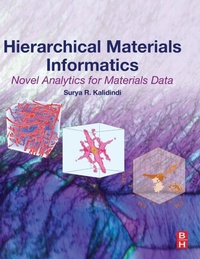
Hierarchical Materials Informatics
Novel Analytics for Materials Data
Published on 13. August 2015
Book
Hardback
230 pages
978-0-12-410394-8 (ISBN)
Description
Custom design, manufacture, and deployment of new high performance materials for advanced technologies is critically dependent on the availability of invertible, high fidelity, structure-property-processing (SPP) linkages. Establishing these linkages presents a major challenge because of the need to cover unimaginably large dimensional spaces. Hierarchical Materials Informatics addresses objective, computationally efficient, mining of large ensembles of experimental and modeling datasets to extract this core materials knowledge. Furthermore, it aims to organize and present this high value knowledge in highly accessible forms to end users engaged in product design and design for manufacturing efforts. As such, this emerging field has a pivotal role in realizing the goals outlined in current strategic national initiatives such as the Materials Genome Initiative (MGI) and the Advanced Manufacturing Partnership (AMP). This book presents the foundational elements of this new discipline as it relates to the design, development, and deployment of hierarchical materials critical to advanced technologies.
More details
Language
English
Place of publication
Woburn
United States
Publishing group
Elsevier - Health Sciences Division
Target group
Professional and scholarly
Materials scientists and engineers and mechanical engineers and researchers across academia, government and industry who are working in the area of new materials design, development and deployment; graduate students in materials science and engineering.
Product notice
Laminated cover
Illustrations
Approx. 130 illustrations
Dimensions
Height: 235 mm
Width: 191 mm
Thickness: 14 mm
Weight
617 gr
ISBN-13
978-0-12-410394-8 (9780124103948)
Copyright in bibliographic data and cover images is held by Nielsen Book Services Limited or by the publishers or by their respective licensors: all rights reserved.
Schweitzer Classification
Other editions
Additional editions
E-Book
08/2015
Butterworth-Heinemann
€118.95
Available for download
Person
Surya R. Kalidindi earned a B.Tech. in Civil Engineering from the Indian Institute of Technology, Madras, an M.S. in Civil Engineering from Case Western Reserve University, and a Ph.D. in Mechanical Engineering from the Massachusetts Institute of Technology. After his graduation from MIT in 1992, Surya joined the Department of Materials Science and Engineering at Drexel University as an Assistant Professor, where he served as the Department Head during 2000-2008. In 2013, Surya accepted a new position as a Professor of Mechanical Engineering in the George W. Woodruff School at Georgia Institute of Technology, with joint appointments in the School of Computational Science and Engineering and in the School of Materials Science and Engineering. Surya's research efforts over the past two decades have made seminal contributions to the fields of crystal plasticity, microstructure design, spherical nanoindentation, and materials informatics. His work has already produced about 200 journal articles, four book chapters, and a new book on Microstructure Sensitive Design. His work is well cited by peer researchers as reflected by an h-index of 52 and current citation rate of about 1000 citations/year (Google Scholar). He has recently been awarded the Alexander von Humboldt award in recognition of his lifetime achievements in research. He has been elected a Fellow of ASME, ASM International, TMS, and Alpha Sigma Mu.
Content
Ch. 1. Materials, Data and InformaticsCh. 2. Microstructure FunctionCh. 3. Spatial CorrelationsCh. 4. Reduced-Order RepresentationsCh. 5. Generalized Composite TheoriesCh. 6. Structure-Property LinkagesCh. 7. Process-Structure LinkagesCh. 8. Emerging Data and Software RepositoriesCh. 9. e-Collaboration PlatformsCh. 10. Future Directions, Needs and Challenges