

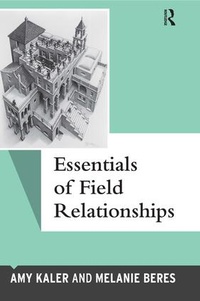
Essentials of Field Relationships
1st Edition
Published on 15. June 2010
Book
Paperback/Softback
128 pages
978-1-59874-332-6 (ISBN)
Description
Field research can consist of trekking across the globe to study peoples in exotic cultural settings. It can also mean strapping on your running shoes and observing behavior at the local market. Regardless of whether the researcher is "at home" or away, the development of research relationships is paramount to the success of the research project. In this book, the authors provide guidance to researchers on developing relationships in their field research. Using a myriad of examples from projects in a wide range of settings, Kaler and Beres offer helpful hints about how to navigate the personal side of conducting research-establishing and maintaining relationships, handling ethical dilemmas, and identifying how the personal identity of researchers help shape their projects.
More details
Series
Language
English
Place of publication
Walnut Creek
United States
Target group
College/higher education
Professional and scholarly
Illustrations
notes, references, index
Dimensions
Height: 229 mm
Width: 152 mm
Weight
181 gr
ISBN-13
978-1-59874-332-6 (9781598743326)
Copyright in bibliographic data and cover images is held by Nielsen Book Services Limited or by the publishers or by their respective licensors: all rights reserved.
Schweitzer Classification
Other editions
Additional editions
Amy Kaler | Melanie Beres
Essentials of Field Relationships
E-Book
09/2016
1st Edition
Routledge
€37.99
Available for download
Amy Kaler | Melanie Beres
Essentials of Field Relationships
E-Book
09/2016
1st Edition
Routledge
€37.99
Available for download
Amy Kaler | Melanie Beres
Essentials of Field Relationships
Book
06/2010
1st Edition
Left Coast Press Inc
€133.69
Shipment within 3-4 weeks
Persons
Amy Kaler is an associate professor in the Department of Sociology and the School of Public Health at the University of Alberta. She studies the institutional contexts of reproductive and sexual health, with emphasis on birth control and sexually transmitted diseases. Her research focuses on southern and eastern Africa and western Canada. She is the author of Running After Pills: Politics, Gender and Contraception in Colonial Zimbabwe and co-editor of The Gendered Society Reader (Canadian edition). She has also published extensively in leading journals in sociology, history, public health, and gender studies.,
Melanie Beres is a lecturer in the Department of Anthropology, Gender and Sociology at the University of Otago, New Zealand. She has conducted field research in Canada and New Zealand. To date, her "field" has remained relatively close to home, including research with transient youth in a small resort community in the Canadian Rockies. She has several previous publications and conference papers based on fieldwork research and about fieldwork, with a focus on research with transient populations. Currently she teaches research methods, theories of social power and social inequality. Her current research projects are focused on exploring power in intimate relationships in local and international contexts.
Melanie Beres is a lecturer in the Department of Anthropology, Gender and Sociology at the University of Otago, New Zealand. She has conducted field research in Canada and New Zealand. To date, her "field" has remained relatively close to home, including research with transient youth in a small resort community in the Canadian Rockies. She has several previous publications and conference papers based on fieldwork research and about fieldwork, with a focus on research with transient populations. Currently she teaches research methods, theories of social power and social inequality. Her current research projects are focused on exploring power in intimate relationships in local and international contexts.
Content
Chapter 1 Introduction; Chapter 2 Transitioning In and Out of the Field; Chapter 3 Maintaining Relationships in the Field; Chapter 4 Establishing and Negotiating a Researcher Identity; Chapter 5 Gathering Data; Chapter 6 Research Ethics; Chapter 7 Concluding Thoughts;